



NEWS&EVENTS
Home > News&Events > Company news > The principle of refining high-purity copper from copper sulfide ore in copper electrolytic cell
In the field of metal smelting, copper electrolytic refining is a key technology for converting copper sulfide ore into high-purity copper. Its principle is sophisticated and its application is wide.
Copper sulfide ore undergoes a complex series of processes, including beneficiation, smelting, and blowing, to produce blister copper. However, blister copper often contains various impurities, including more reactive metals like iron, zinc, and nickel, as well as less reactive precious metals like gold, silver, and platinum. This is where copper electrolytic refining plays a key role.
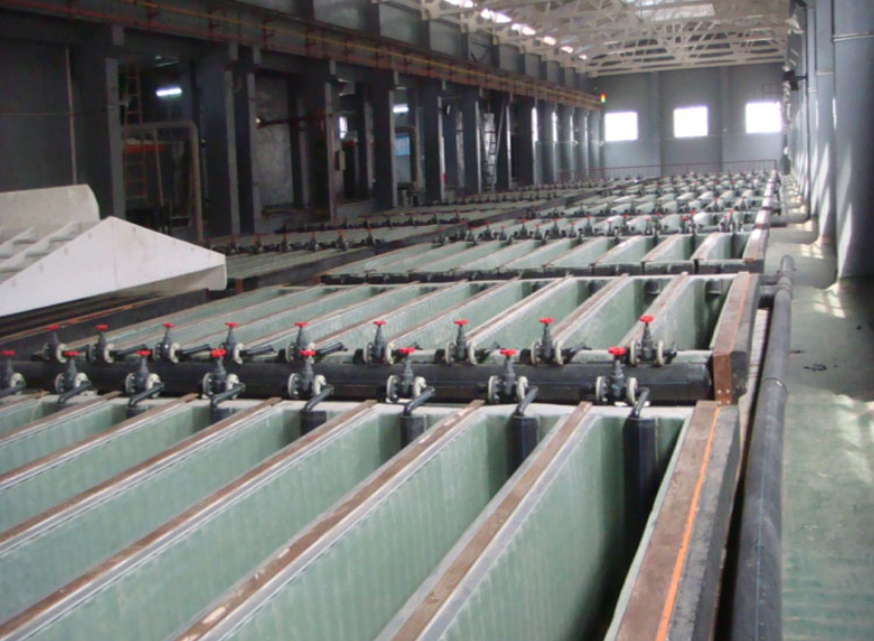
A carefully prepared anode plate is placed in an electrolytic cell containing copper sulfate and sulfuric acid, and a direct current is passed through it. A remarkable electrochemical reaction unfolds. Under the influence of the current, an oxidation reaction occurs at the anode, causing the copper and metals more reactive than copper in the crude copper to lose electrons and transform into ions that enter the solution. The copper ions dissolve as divalent copper, while ions of metals more reactive than copper also enter the solution, but are subsequently processed under specific conditions.
At the same time, a reduction reaction occurs at the cathode. The copper ions in the solution gain electrons, depositing pure copper on the cathode surface. After a long period of electrolysis, a thick layer of pure copper with a purity of up to 99.99% gradually accumulates on the cathode, meeting the stringent requirements for high-quality copper materials in many industries, including electronics and electrical engineering.
Precious metals that are less active than copper, such as gold, silver, and platinum, do not lose electrons into the solution during the electrolysis process and therefore gradually sink to the bottom of the tank, forming "anode mud." This "anode mud" is a valuable resource and an important raw material for precious metal recovery, with enormous economic value.
Copper electrolytic refining technology and equipment not only achieve high-purity copper extraction, but also open up new ways for the recycling of precious metals, playing an irreplaceable role in efficient resource utilization and environmental protection.