



NEWS&EVENTS
Home > News&Events > Company news > Strict requirements for copper electrolytic cell installation and the reasons therefor
The installation of copper electrolytic cells has extremely strict requirements for "levelness" and "alignment". Specifically, the cells must be installed at an absolutely level level, and the center lines of the conductive bases of all copper electrolytic cells must be on the same straight line.
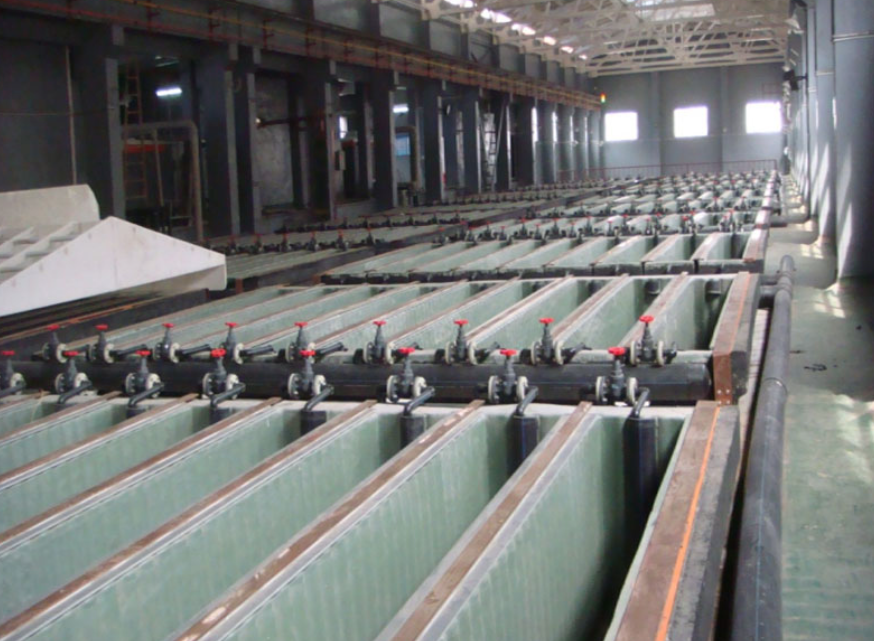
Strict levelness requirements are crucial. A specific electrode spacing exists between the anode and cathode within the copper electrolytic cell. If the cell is not level, the electrode spacing will be unevenly distributed. In some areas, the electrode spacing may be too small, causing direct contact between the anode and cathode, leading to short circuits. This not only affects normal production but may also damage the equipment. Conversely, in some areas, the electrode spacing may be too large, increasing resistance during electrolysis, resulting in significantly higher power consumption, reduced energy efficiency, and increased production costs.
The requirements for moderate contact resistance are equally important. If the resistance is poor, the anode and cathode plates cannot overlap properly, resulting in a significant increase in contact resistance. During electrolysis, this increased resistance causes excessive heat generation in localized areas, leading to localized overheating, accelerating equipment aging, and shortening its lifespan. Furthermore, increased contact resistance affects the normal distribution of current, causing uneven current flow through the electrolytic cell. This results in some areas having excessively high current while others have insufficient current, reducing current efficiency and impacting the quality and yield of the electrolyzed products.
Furthermore, for copper electrolytic cells employing permanent cathode technology, precise electrode spacing is fundamental to the normal operation of automated equipment such as cathode stripping units. If levelness and alignment cannot be guaranteed, resulting in electrode spacing deviations, automated units may experience problems such as jamming and malfunctions during operation, affecting the stability and continuity of the entire production process. Therefore, strictly controlling the levelness and alignment of copper electrolytic cell installation is crucial to ensuring the safe, efficient, and stable operation of electrolytic production.