



NEWS&EVENTS
Home > News&Events > Company news > The role of anode plates and cathode plates in antimony electrolysis equipment
In antimony electrolysis equipment, anode plates and cathode plates play a vital role. Their material selection and performance requirements directly affect the efficiency and quality of the electrolysis process.
Anode plates are typically made from smelted crude antimony. During the electrolysis process, the anode plate serves as the anode, where the antimony loses electrons. After losing electrons at the anode, the antimony dissolves into the electrolyte, initiating the electrolysis reaction. To ensure a smooth electrolysis process, the anode plate material must be of high purity. The presence of impurities may interfere with the electrolysis reaction, causing unwanted side reactions and reducing electrolysis efficiency and product quality.
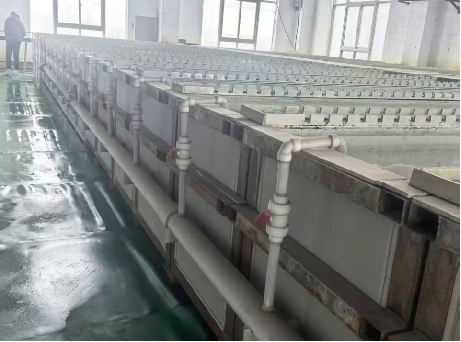
At the same time, the anode plate must have a certain mechanical strength. During the electrolysis process, it has to withstand the pressure of the electrolyte, the action of the current, and its own gravity. If the mechanical strength is insufficient, it is prone to deformation, breakage and other problems, affecting the continuity and stability of production.
The cathode plate is typically made of a material with good conductivity, such as stainless steel. Its function is to provide electrons for the electrolysis process, allowing antimony ions in the electrolyte to precipitate after receiving electrons at the cathode, ultimately forming cathode antimony. Electrical conductivity is the primary requirement for cathode plate materials. Good conductivity ensures rapid and stable electron transfer, improving electrolysis efficiency. Corrosion resistance is also essential. The electrolyte is somewhat corrosive, and if the material is not corrosion-resistant, the cathode plate's service life will be shortened, increasing production costs. Furthermore, the cathode plate surface must be smooth. A smooth surface facilitates uniform antimony precipitation, avoiding uneven antimony deposition and thus ensuring the quality and appearance of the cathode antimony.
In short, the rational selection of materials for anode and cathode plates and ensuring that they meet the corresponding performance requirements are key factors in achieving efficient, stable and high-quality production in antimony electrolysis production.