



NEWS&EVENTS
Home > News&Events > Company news > Analysis of the structure and working principle of copper electrolytic cells.
The copper electrolytic cell is the core equipment in the copper refining process, using electrochemical principles to purify crude copper into high-purity cathode copper. The efficient operation of this refining process depends on the precise design and coordinated operation of its five key structures.
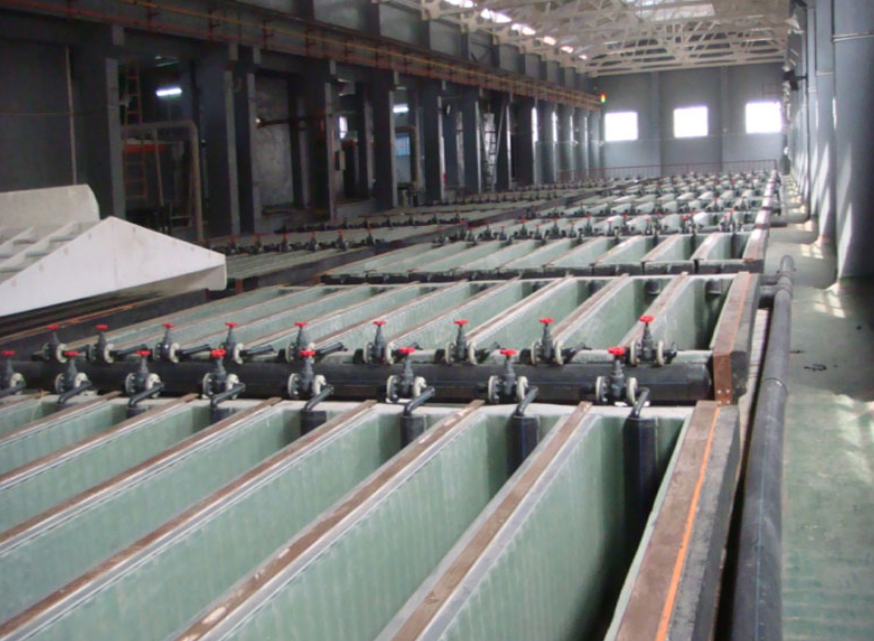
First, the cell body is the physical foundation of the entire system. As an acid-resistant, insulating container, it holds the internal reaction system. Modern cell bodies are mostly made of polymer concrete, ensuring their stability and durability in high-temperature, strong-acid environments.
The anode and cathode, located inside the cell body, are where the chemical transformations directly occur. The anode is cast from crude copper; when electricity is applied, copper and active impurities selectively dissolve into the solution, while insoluble precious metals settle as valuable anode sludge. The opposite cathode, usually based on a titanium starter sheet, is where pure copper ions receive electrons and deposit to form the final product – bright, mirror-like electrolytic copper plates.
The medium connecting the anode and cathode is the electrolyte, mainly a hot solution of copper sulfate and sulfuric acid. It is not only a channel for ion migration, but its constant composition, temperature, and circulating flow are crucial for ensuring uniform cathode copper quality and continuous production. A dedicated circulation system continuously purifies and replenishes it.
Driving the entire system is the invisible conductive system. Large copper busbars, inter-cell conductive plates, and conductive rods on the electrodes form a low-resistance current network. It precisely and evenly delivers DC power to each anode and cathode.
In summary, the copper electrolytic cell is a complex system integrating electrical, chemical, and mechanical engineering. Starting with the input of electrical energy from the conductive system, the current flows sequentially through the anode, electrolyte, and cathode, driving copper ions to migrate from the crude anode to the pure cathode, ultimately achieving the purification of copper.