



NEWS&EVENTS
Home > News&Events > Company news > Concrete-Lined FRP Electrolytic Cell – Core Equipment for Copper Electrolysis
In the electrolytic refining of scrap copper, the copper electrolytic cell serves as the core equipment that determines both the quality of the cathode copper and overall production efficiency. Currently, the industry widely adopts a structural design featuring a reinforced concrete tank body lined with Fiber-Reinforced Polymer (FRP); this configuration combines high structural strength with excellent corrosion resistance, making it the ideal choice for copper electrolysis workshops.
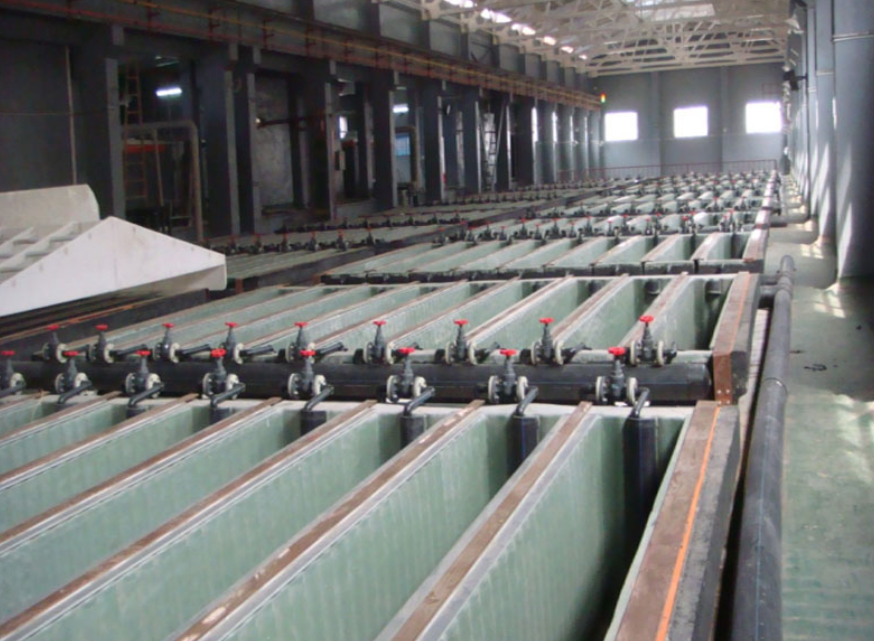
Reinforced concrete possesses superior mechanical strength and structural stability, enabling it to support the weight of several tons of electrolyte and electrode plates, as well as dynamic loads associated with hoisting operations. It effectively withstands temperature fluctuations and cyclic stresses without easily deforming or cracking, thereby ensuring the vertical alignment of electrode plates and uniform inter-electrode spacing—a critical foundation for reliable production.
However, the electrolyte—a copper sulfate-sulfuric acid system—is highly acidic and strongly oxidative, rendering ordinary concrete susceptible to corrosion. Consequently, the inner walls of the tank are lined with an FRP layer. Composed of a composite of resin and glass fibers, FRP exhibits exceptional resistance to acids and high temperatures, along with excellent electrical insulation properties; it effectively isolates the acidic electrolyte, thereby preventing corrosion of the steel reinforcement and spalling of the concrete. Furthermore, its smooth surface and high electrical resistivity minimize parasitic currents and reduce the risk of short circuits, while also facilitating the removal of anode slime. Additionally, FRP possesses a degree of elasticity, which helps to cushion and mitigate potential damage caused by accidental impacts with the electrode plates.
Modern copper electrolysis operations are trending toward higher current densities (ranging from 280 to 330 A/m²) and shorter processing cycles, utilizing narrow inter-electrode spacing of only 95 to 100 mm; this places increasingly stringent demands on the electrical insulation and dimensional precision of the electrolytic cells. The aforementioned structural design fully meets these rigorous specifications while offering moderate capital investment requirements, ease of maintenance, and an extended service life for each individual cell.
In summary, the reinforced concrete electrolytic cell lined with FRP has established itself as an indispensable core component within copper electrolysis workshops, distinguished by its reliable mechanical performance, superior corrosion resistance, and favorable economic viability. It provides a robust and steadfast guarantee for the stable production of high-purity cathode copper.