



NEWS&EVENTS
Home > News&Events > Company news > Copper Electrolytic Refining Process | Purification of Crude Copper to 99.99%
Electrolytic refining is currently the dominant process for copper purification; the vast majority of refined copper produced globally is generated using this method. Utilizing electrochemical principles, it efficiently purifies crude copper—typically containing about 99% copper—to a purity level exceeding 99.99%.
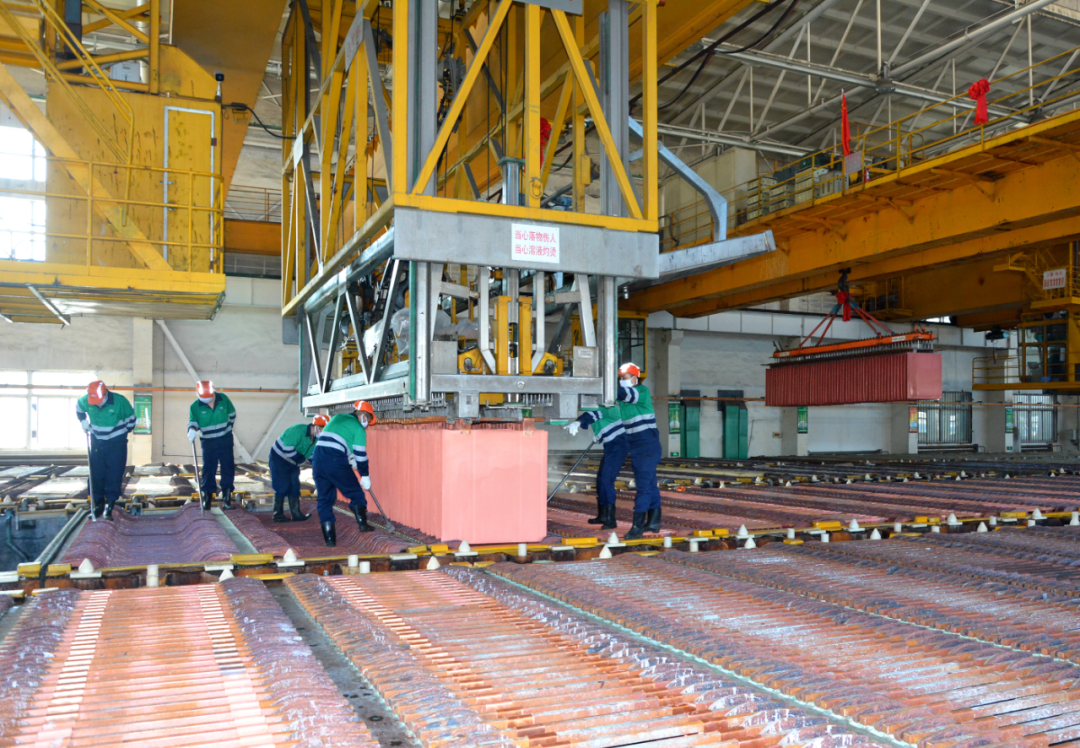
Working Principle: The "Transfer" from Anode to Cathode
Crude copper is cast into thick plates to serve as anodes, while thin sheets of pure copper or stainless steel plates act as cathodes; these are immersed in an electrolytic cell containing a mixed solution of copper sulfate and sulfuric acid. Upon the application of direct current, copper atoms at the anode dissolve into copper ions, entering the solution. These copper ions then migrate toward the cathode, where they gain electrons and deposit as electrolytic copper of exceptionally high purity. The entire process effectively amounts to the "transfer" of copper from the anode to the cathode, while the concentration of copper ions within the solution remains essentially constant.
The Fate of Impurities: Precious Metals as "Windfalls"
Electrolytic refining ingeniously leverages the differences in the electrode potentials of various metals. Precious metals—such as gold, silver, platinum, and palladium—possess more positive electrode potentials than copper; consequently, they do not dissolve during electrolysis but instead settle at the bottom of the tank in the form of "anode slime." This anode slime serves as a valuable raw material for the recovery of precious metals; for instance, every ton of copper anode slime typically contains approximately 2,000 to 3,000 grams of gold. Large-scale domestic smelters are able to recover over ten tons of gold and hundreds of tons of silver annually solely from this anode slime. Conversely, more reactive metals—such as iron, zinc, and nickel—do dissolve alongside the copper; however, they do not readily deposit onto the cathode and instead remain dissolved within the electrolyte, necessitating periodic purification treatments.
The Workshop Environment: Precision-Controlled, Large-Scale Production
Stepping into a modern electrolytic copper refinery, one encounters hundreds of electrolytic cells arranged in neat rows. Inside each cell, anode plates and cathode plates are alternately spaced. Once the current is applied, the anodes gradually dissolve, while thick, lustrous layers of electrolytic copper continuously accumulate upon the cathodes. In standard processes, the current density typically ranges from 220 to 280 A/m²; however, by employing permanent stainless steel cathode technology, this density can be increased to between 320 and 370 A/m², achieving a current efficiency exceeding 97%.