



NEWS&EVENTS
Home > News&Events > Company news > Process for Producing Copper Anode Plates Using a Tilting Rotary Furnace
The tilting rotary furnace is a critical piece of equipment in the production of copper anode plates. Its production process is primarily divided into three core stages—charging and melting, oxidation, and reduction—which work in close coordination to ensure the output of high-quality anode plates.
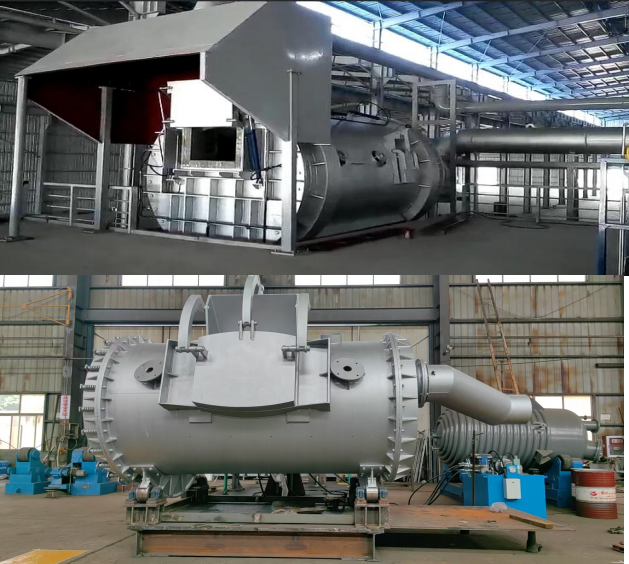
1. Charging and Melting Stage
A charging machine feeds the copper material into the tilting rotary furnace. To ensure the complete melting of the copper, the furnace chamber temperature must be raised to above 1250°C. Once melting is complete, any slag floating on the surface of the molten copper is promptly skimmed off to prepare for the subsequent stages.
2. Oxidation Stage
The furnace body is rotated to an appropriate angle, and compressed air is blown into the molten copper through an oxidation-reduction lance. Additionally, slag-forming agents—such as quartz—are introduced. Once the slag-forming reaction is complete, the resulting oxide slag is promptly skimmed out.
3. Reduction Stage
High-pressure natural gas is utilized as the reducing agent. The furnace door is opened, and either a wooden pole is immersed into the molten copper, or the furnace body is rotated to allow natural gas to be injected into the molten copper through the oxidation-reduction lance. This creates a strong reducing atmosphere, thereby reducing the oxidized copper back into metallic copper.
In summary, the tilting rotary furnace achieves the efficient purification and compositional control of molten copper through the seamless integration of three distinct processes: charging and melting, oxidation, and reduction. The melting stage establishes the necessary thermal and cleanliness foundations; the oxidation stage precisely removes harmful impurities; and the reduction stage, utilizing natural gas, converts copper oxides back into metallic copper. Ultimately, this process yields high-quality molten copper with stable composition and controllable oxygen content, providing a reliable guarantee for the subsequent casting of qualified anode plates. This process boasts several advantages—including operational flexibility, strong impurity removal capabilities, and significant reduction efficiency—and plays a pivotal role in modern copper smelting operations.