



NEWS&EVENTS
Home > News&Events > Company news > Key Considerations for Equipment Selection in New Electrolytic Copper Plants
Equipment selection for a new electrolytic copper plant must be approached systematically, centering on production capacity, process routing, and the level of automation. The core objective is to ensure the optimal integration and compatibility of the electrolysis system, electrode processing units, and supporting utility systems.
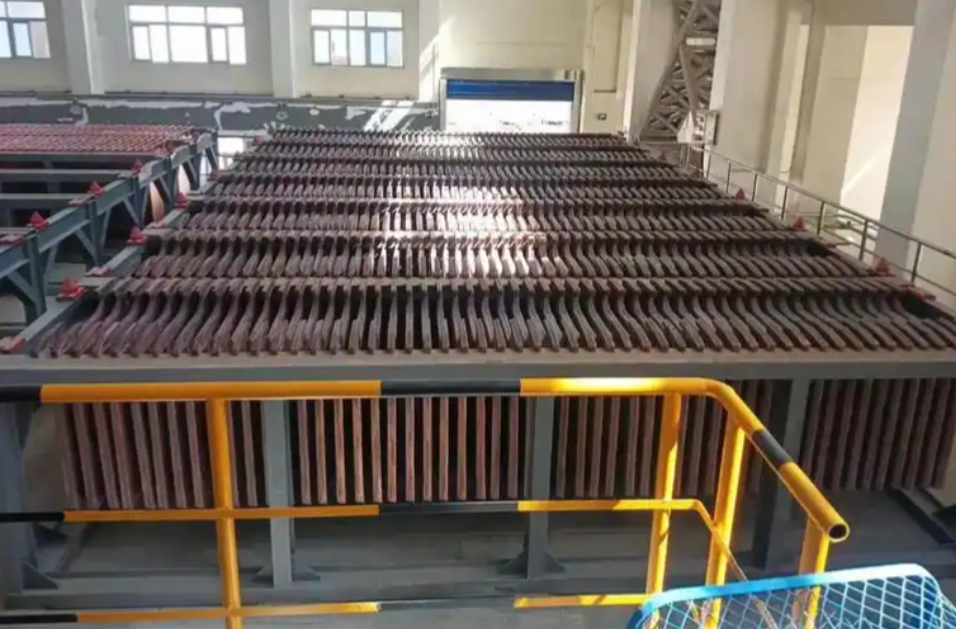
Preferred Process Route: Modern large-scale copper plants widely adopt the permanent cathode method, utilizing stainless steel plates as cathodes. This approach eliminates the need for starter sheet production, resulting in products with superior flatness and facilitating a high degree of automation. Electrolytic cells should be constructed from materials exhibiting excellent corrosion resistance, superior electrical insulation properties, and a long service life. For the DC power supply, Silicon Controlled Rectifiers (SCRs) are recommended, featuring a control accuracy of no less than ±1%.
Key Processing Units:The cathode stripping unit serves as the core of the automation system; it should be equipped with robotic capabilities for automatic stripping, washing, stacking, and bundling, with a processing capacity precisely matched to the plant's overall production output. Anodes must undergo processing via a shaping unit—involving flattening and lug milling—to ensure uniform electrical conductivity. Overhead cranes within the workshop must be acid-resistant and possess high load-bearing capacities, operating in conjunction with a Distributed Control System (DCS) to enable intelligent, end-to-end process management.
Auxiliary Systems: For electrolyte circulation, priority should be given to bidirectional parallel flow technology, which supports high current densities (e.g., 380 A/m²) and enhances operational efficiency. The acid mist treatment system must achieve a purification efficiency exceeding 98%. Additionally, the facility requires supporting stations for purified water, circulating cooling water, and compressed air.
Selection Principles:The selection process should adhere to the principles of being "advanced, reliable, and economical," prioritizing solutions that enable high current density operations while maximizing energy efficiency and environmental protection. Emphasis must be placed on total lifecycle costs, and adequate space should be reserved to accommodate future capacity expansion. Based on the projected annual production volume, precise calculations must be performed to determine the required number of electrolytic cells, rectifier capacity, and processing unit capabilities, thereby ensuring a balanced and harmonious match across all stages of the production chain. Through judicious equipment selection, it is possible to realize a modern electrolytic copper production facility characterized by high efficiency, low energy consumption, and superior product quality.