



NEWS&EVENTS
Home > News&Events > Company news > How do rotary copper smelting furnaces adapt to the complex requirements of copper concentrate smelting?
How do rotary copper smelting furnaces adapt to the complex requirements of copper concentrate smelting? As a dynamic smelting device, it achieves intense mixing of materials at high temperatures through furnace body rotation or lance oscillation, rapidly completing oxidation smelting and slag formation reactions, and achieving efficient separation of copper matte and slag.
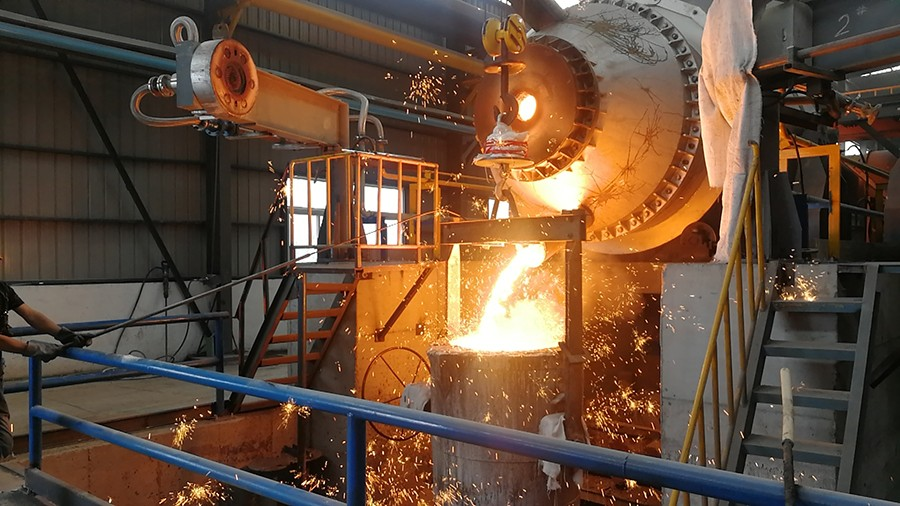
Complex copper concentrates have large fluctuations in composition, high impurity content, abnormal sulfur/iron ratios, or a high proportion of refractory minerals. The structural characteristics of the rotary furnace give it superior adaptability to these materials:
1. Material adaptability and flexible reaction: Furnace body rotation or lance stirring ensures sufficient contact between materials and oxygen, and rapid and uniform reactions are achieved by adjusting lance parameters; temperature, oxygen potential, and alkalinity can be adjusted online to optimize the process for different impurities.
2. High thermodynamic and kinetic efficiency: The lance directly injects high-concentration oxygen-enriched air, resulting in high reaction intensity, fast reaction speed, and large processing capacity; strong convection within the melt accelerates oxidation and slag formation reactions, improving copper recovery rate and allowing for the processing of refractory minerals.
3. Excellent environmental and economic benefits: Good sealing performance produces high-concentration SO₂ flue gas, which is convenient for acid production; the self-heating reaction reduces or eliminates the need for additional fuel, resulting in low energy consumption; it is mostly continuous operation, ensuring stable production and easy automation.
4. Specialized design to handle complex compositions: The furnace lining uses high-grade chrome-magnesia bricks to control the slag layer protection, providing corrosion resistance and erosion resistance; the strong oxidizing atmosphere and controllable oxygen potential promote the volatilization and removal of impurities, which are then recovered through a flue gas treatment system.
Through its core structural design, the rotary copper smelting furnace achieves high-intensity, high-efficiency, and low-emission smelting. It is more adaptable to complex copper concentrates than traditional fixed-bed smelting furnaces, enabling stable and efficient production and controlling pollution at the source. It is a key technology for the green upgrading of modern copper metallurgy. Although the investment is higher and the operation is more complex, the overall benefits are significant.