



NEWS&EVENTS
Home > News&Events > Company news > In what ways does the copper electrolytic cell exhibit strong adaptability to raw materials?
Copper electrolytic cells demonstrate strong adaptability to raw materials in copper smelting production, primarily due to their ability to process various types of copper-containing raw materials.
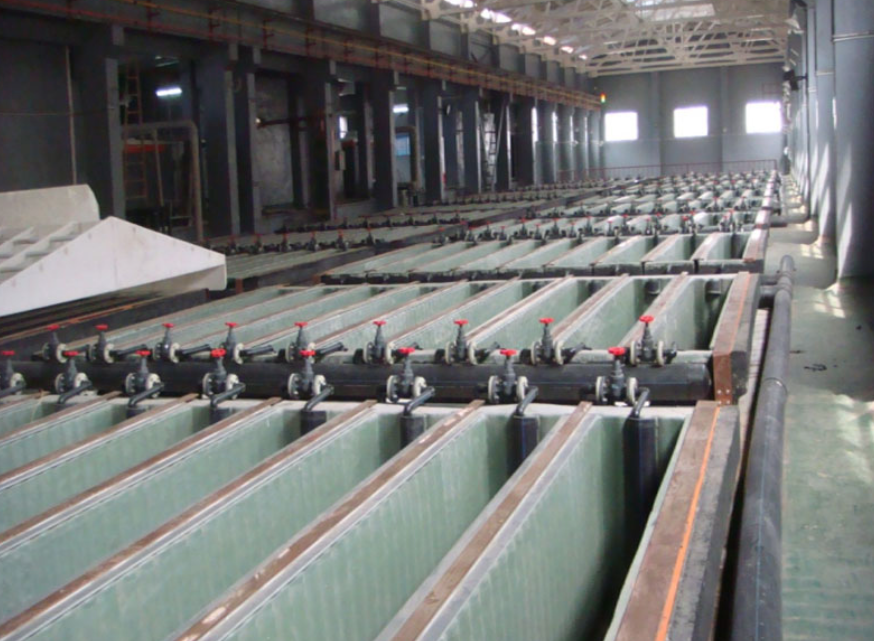
Firstly, they can process blister copper produced by pyrometallurgical refining. Pyrometallurgical blister copper contains not only copper but also precious metals such as silver and gold. When processing this type of raw material, the copper electrolytic cell utilizes the principle of electrolysis, causing copper to deposit at the cathode, while impurities such as precious metals remain in the anode slime. This achieves effective separation of copper and precious metals, ensuring the purity of the cathode copper and enabling the recovery and reuse of precious metals, thus improving the comprehensive utilization rate of resources.
Secondly, copper electrolytic cells can also handle hydrometallurgical leaching solutions, such as copper ore heap leaching solutions. Leaching solutions obtained from hydrometallurgy have complex compositions, containing various metal ions and impurities. Through the copper electrolytic cell, under suitable electrolytic conditions, copper ions can be selectively reduced to metallic copper and deposited on the cathode, while other impurities remain in the electrolyte or form anode slime, thereby achieving the extraction and purification of copper.
Furthermore, recycled copper is also processed by copper electrolytic cells, such as copper recovered from waste wires and circuit boards. These recycled copper raw materials have diverse sources, fluctuating composition, and high impurity content. However, by adjusting the electrolyte formula, such as by adding a colloidal inhibitor, copper electrolytic cells can effectively suppress the deposition of impurities at the cathode, ensuring the purity of the cathode copper.
In summary, copper electrolytic cells, with their unique electrolysis principle and flexible operation, can adapt to copper-containing raw materials from various sources and with different compositions, providing the copper smelting industry with an efficient and stable production method, playing a vital role in improving resource utilization and reducing production costs.