



NEWS&EVENTS
Home > News&Events > Company news > What are the outstanding advantages of tilting crucible copper melting furnaces?
Thanks to its unique design, the tilting crucible copper melting furnace offers significant advantages in the smelting of copper and copper alloys.
First, operational safety and working conditions are substantially improved. In traditional crucible furnaces, molten metal is manually ladled out; operators must work in close proximity to molten copper exceeding 1000°C, facing high risks of burns and thermal radiation injuries. The tilting copper melting furnace, however, utilizes mechanical or hydraulic tilting mechanisms to smoothly tilt the furnace body, allowing the molten copper to flow out automatically along a guide spout. Operators can control this process remotely or mechanically, keeping a safe distance from high-temperature zones, thereby minimizing direct contact with the molten metal, enhancing production safety, and improving the working environment.
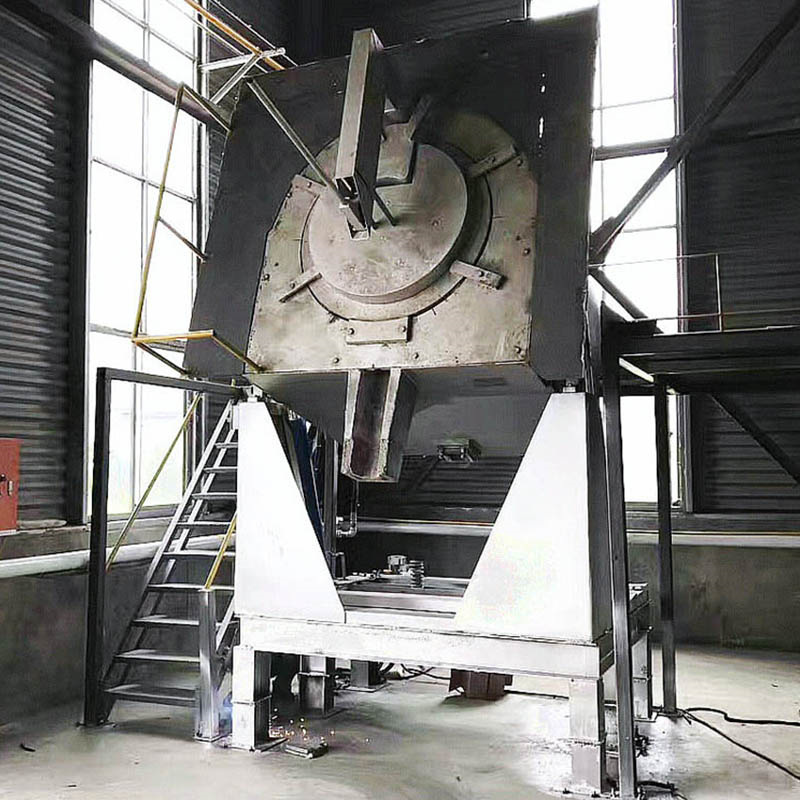
Second, molten metal discharge is rapid and highly efficient. This furnace model is capable of rapid, high-flow pouring; the volume of molten metal discharged per unit of time far exceeds that of manual ladling. This capability is critical for production scenarios involving large-batch, centralized casting, as it shortens casting cycles, facilitates continuous and rhythmic production flows, and boosts both equipment utilization rates and overall production capacity.
Third, alloy switching is convenient and flexible. With traditional furnace models, switching between different alloy grades is often complicated because residual molten metal at the furnace bottom is difficult to drain completely, potentially leading to complex cleaning procedures or the cross-contamination of new and old alloys. The tilting crucible furnace, conversely, can completely drain all residual molten copper from the furnace interior, enabling rapid transitions to the smelting of alloys with different compositions. This reduces the time required for furnace cleaning and washing, lowers the risk of cross-contamination, and makes the furnace ideally suited for multi-variety, small-batch production environments.
Fourth, the structure is compact and space-saving. This furnace model integrates the furnace body, tilting mechanism, and combustion/heating system onto a single base, resulting in a small footprint. For enterprises with limited workshop space or requirements for compact equipment layouts, this design offers distinct advantages in terms of spatial planning and utilization.
In summary, the tilting crucible copper melting furnace stands out for its superior advantages in safety, efficiency, flexibility, and space utilization. It represents an ideal choice for modern copper alloy smelting workshops—particularly those requiring frequent alloy changes or engaging in large-batch casting operations.