



NEWS&EVENTS
Home > News&Events > Company news > The Core Objective of Refining Blister Copper in a Rotary Anode Furnace
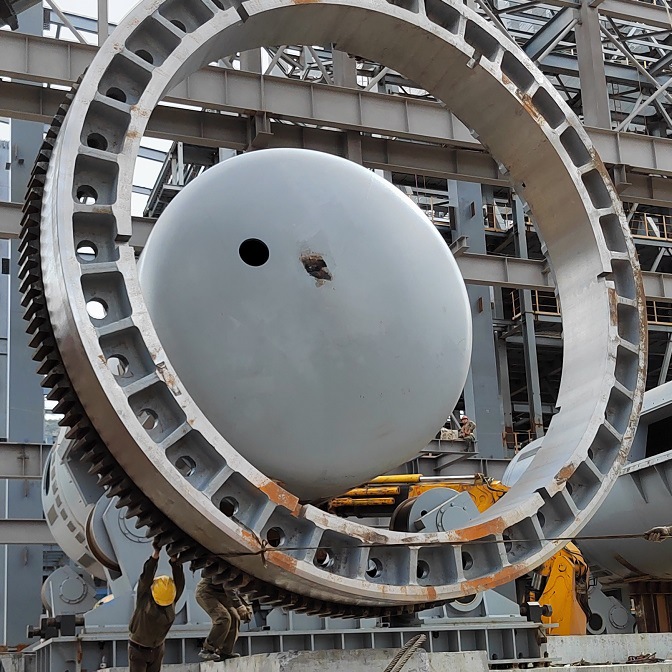
The rotary anode furnace is a critical piece of equipment in copper smelting, serving to refine blister copper (containing approximately 98.5% copper) into anode copper; this process achieves high-quality refining through the dual operations of "impurity removal and oxygen regulation."
I. Deep Removal of Harmful Impurities
Blister copper contains various impurities such as S, Fe, Pb, Zn, As, and Sb; if these remain, they will severely compromise the subsequent electrolytic refining process. During the oxidation stage, compressed air or oxygen-enriched air is injected into the molten copper bath. This causes the impurities to react with oxygen, forming oxides which then combine with fluxes—such as quartz sand—to create a slag that floats to the surface for removal, thereby achieving the deep elimination of impurities like Fe, Pb, Zn, and S.
II. Precise Control of Oxygen Content
Following oxidation, the oxygen dissolved within the molten copper (present in the form of Cu₂O) must be reduced to below 0.1%. Excessively high oxygen levels would diminish the copper's electrical conductivity and ductility, potentially resulting in porous copper castings. During the reduction stage, a reducing agent is introduced to regulate the oxygen content within an optimal range, thereby ensuring that the cast anode plates are free of pores and cracks.
III. Compliance with Electrolytic Refining Standards
The final anode copper product must maintain a stable copper content of 99.3% to 99.5%, with impurity levels—such as Fe ≤ 0.01% and Pb ≤ 0.005%—meeting strict specifications. Only anode plates that meet these standards can dissolve efficiently within the electrolytic cells to yield cathode copper with a purity exceeding 99.99%; failure to meet these criteria would result in reduced current efficiency or even the complete spoilage of an entire electrolytic cell batch.
In summary, the rotary anode furnace fundamentally executes a precise metallurgical operation involving the "removal of impurities and regulation of oxygen" within the molten copper bath—a process that directly determines the success of the subsequent electrolytic refining stage and the ultimate quality of the final cathode copper product.