



NEWS&EVENTS
Home > News&Events > Company news > Selection of Major Equipment for the Electrolytic Copper Workshop
I. Electrolytic Cell Selection: FRP Cells and Electrolyte Flow Configuration
Fiberglass-reinforced plastic (FRP) electrolytic cells are designed with a top-inlet, bottom-outlet configuration, which facilitates uniform electrolyte distribution and the settling of anode slime. FRP is corrosion-resistant and offers a long service life, making it well-suited for hydrometallurgical processes such as copper electrolysis.
II. DC Power Supply Configuration: Silicon Rectifiers vs. Thyristor Rectifiers
Small to medium-sized copper electrolysis plants typically favor silicon rectifiers due to their moderate investment cost and stable operation. Large-scale facilities may incorporate thyristor rectifiers to achieve greater control precision.
III. Anode Plate Sizing: Matching Production Scale and Automation Levels
The dimensions of anode plates are closely linked to production scale, the level of operational automation, and other technical parameters. Large-scale facilities with high degrees of mechanization generally utilize large anode plates, often weighing over 300 kg each. Conversely, small to medium-sized plants with lower levels of mechanization typically employ smaller anode plates to simplify lifting and handling operations.
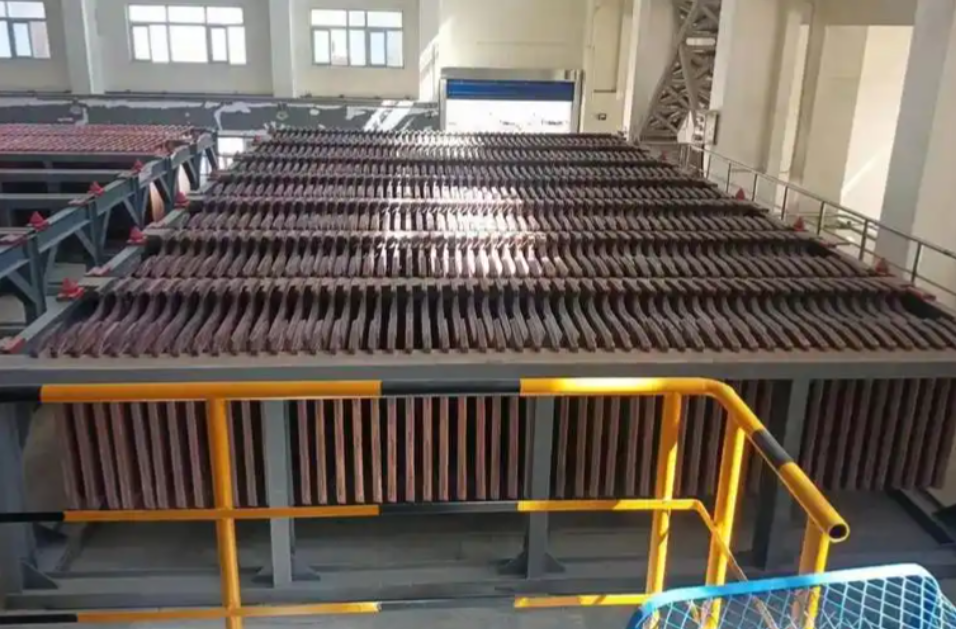
IV. Cathode Material: 316L Stainless Steel
Cathodes are fabricated from 316L stainless steel, which offers excellent resistance to electrolyte corrosion and high electrical conductivity, making it ideal for long-term, repeated use.
V. Copper Busbars: Connecting Rectifier Outputs to Electrolytic Cells
Copper busbars serve as the connection between the rectifier output and the electrolytic cells, facilitating the transmission of direct current (DC). Their specifications must be selected to meet requirements for current-carrying capacity and temperature rise limits.
VI. Electrolyte Circulation System: Circulation Tanks, Head Tanks, and Pumps
Circulation tanks, head tanks, and anode slime storage tanks are constructed from FRP to ensure resistance to acid and alkali corrosion. Electrolyte circulation pumps ensure the stable transport of the electrolyte within the top-inlet, bottom-outlet process; these must be selected based on required flow rate and head (pressure).
VII. Electrode Handling Systems
Electrode handling systems are used for the lifting, transport, and loading/unloading of anodes and cathodes. The level of automation in these systems directly influences the choice of anode plate dimensions and the overall production capacity of the facility. Please contact us if you would like to obtain an equipment configuration list for a copper electrolysis plant or a comprehensive solution for copper electrolysis.