



NEWS&EVENTS
Home > News&Events > Company news > Transmission and support of antimony smelting equipment rotary kiln
In high-temperature treatment processes such as antimony smelting, the stable operation of rotary kilns is crucial as the core equipment. The rotating body of a large rotary kiln is large and heavy, and its smooth operation relies on a precise mechanical system, among which the transmission system and support system are the two cornerstones. The transmission is usually completed by a large gear ring driven by an electric motor, while the support mainly relies on the precise fit between the supporting wheel and the blocking wheel.
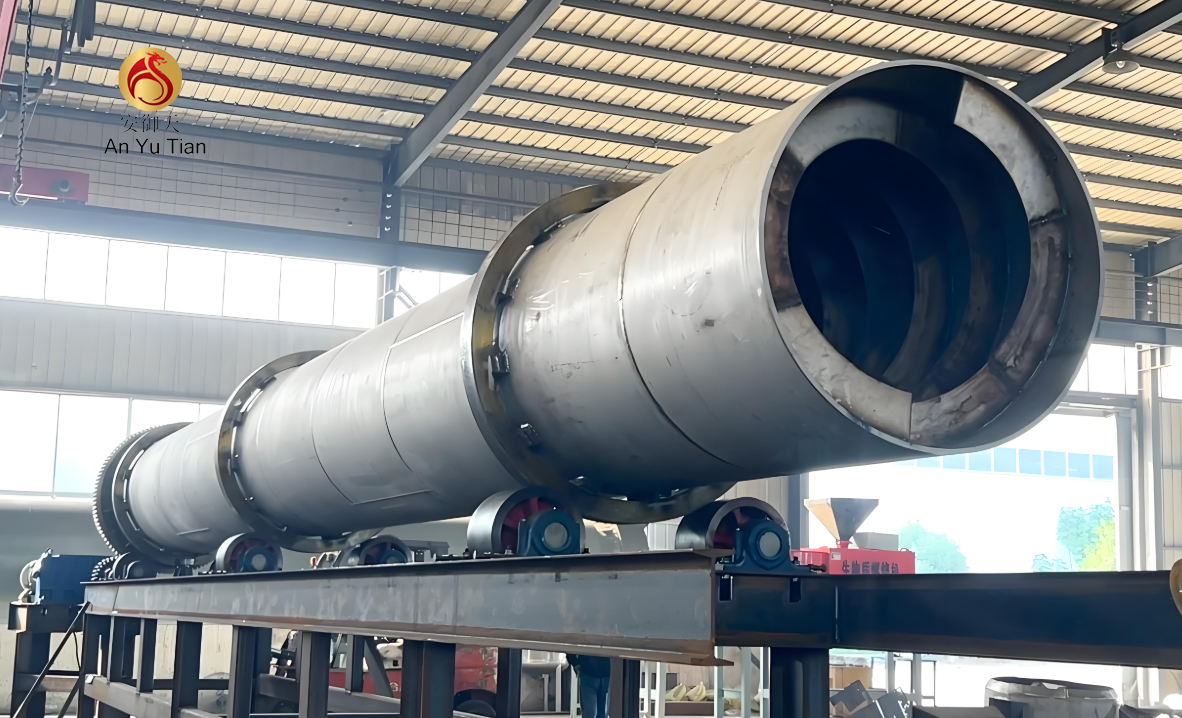
The core function of the supporting wheel is twofold: firstly, it bears the entire weight of the kiln body, refractory bricks, and materials through contact with the wheel belt on the kiln body, and is the main radial support; Secondly, by adjusting the relative angle between its axis and the axis of the kiln body, a subtle axial force is generated under the action of friction, which assists in controlling the slow and regular reciprocating movement of the kiln body in the axis direction, which is beneficial for the uniform wear of the wheel belt and supporting wheel. And the responsibility of the blocking wheel is to limit the axial position of the kiln body. It is usually installed on both sides of the wheel belt near the large gear ring and is not primarily load-bearing. When the kiln body experiences abnormal axial displacement beyond the design range due to various factors such as installation errors and temperature changes causing thermal expansion and contraction, the stop wheel will come into contact with the side of the wheel belt, issuing a warning signal to prevent serious faults such as gear ring misalignment and seal damage caused by excessive movement of the equipment.
In summary, the transmission system and support system of the rotary kiln do not operate in isolation, but are a precision coordinated whole. The transmission system provides smooth rotational power, while the support system composed of supporting wheels and blocking wheels jointly shoulders the multiple missions of load-bearing, positioning, and protection. The supporting wheel ensures stable radial support and controllable axial movement of the kiln body, while the blocking wheel guards the safety boundary of axial movement. The tacit cooperation between the two enables the large and heavy kiln body to achieve stable and long-term continuous operation under harsh conditions of high temperature and heavy load, becoming the core foundation for ensuring smooth and efficient high-temperature processes such as antimony smelting.