



NEWS&EVENTS
Home > News&Events > Company news > Copper Electrolytic Cell: Key Control Points from Anode Plate to High-Purity Cathode Copper
Copper electrolytic refining is the core process of converting anode plates into high-purity cathode copper. Product purity and production efficiency depend on several key control points, and precise control of these aspects is crucial for high-quality, low-energy consumption production.
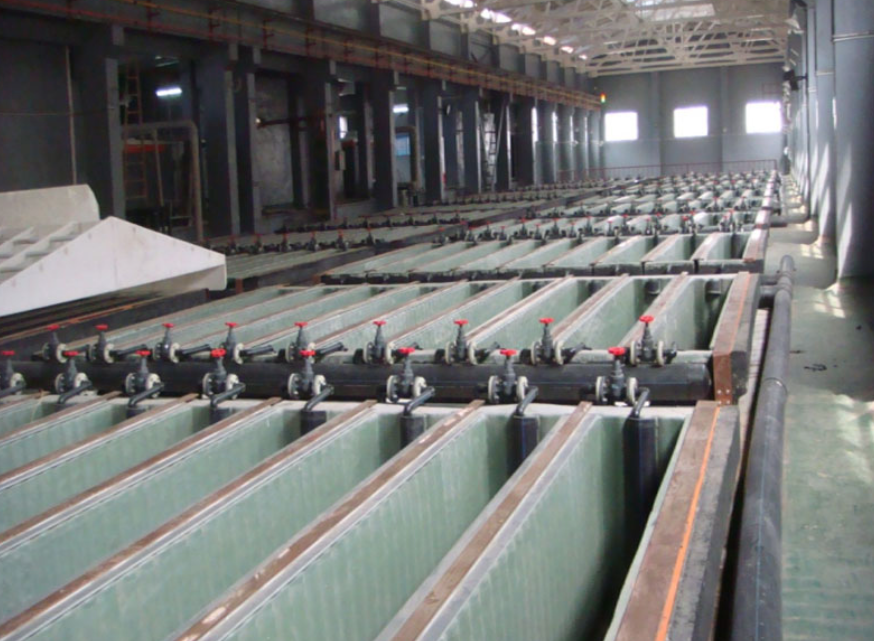
Firstly, stable control of the electrolyte composition is fundamental. The concentrations of copper ions (Cu²⁺) and sulfuric acid (H₂SO₄) must be maintained within the optimal balance range. Too high a copper ion concentration can lead to anode passivation and rough cathode deposition; too low a concentration reduces current efficiency and increases the risk of impurity deposition. Sulfuric acid concentration affects solution conductivity; an appropriate concentration reduces cell voltage and saves energy, while too high a concentration exacerbates equipment corrosion. Continuous circulation, purification, and analysis of the electrolyte are prerequisites for ensuring high current efficiency and the deposition of high-purity cathode copper.
Secondly, the cell voltage optimization strategy is crucial for energy cost. Cell voltage consists of the electrolyte voltage drop, electrode potential, and contact voltage, making the electrode spacing design critical. Reducing the distance between the anode and cathode can lower the electrolyte voltage drop and save energy, but too small a distance increases the risk of short circuits and affects production stability. Precise mechanical positioning and automatic inspection are necessary to find the optimal spacing that ensures current efficiency while minimizing energy consumption.
Thirdly, the mechanism of action of additives is a core technology for obtaining high-quality cathode copper. Commonly used additives are added to the electrolyte in trace amounts. They selectively adsorb onto the active growth points on the cathode copper surface, inhibiting the rapid and disordered growth of copper crystals, promoting the formation of a uniform and fine crystalline structure, resulting in a smooth and easily peelable cathode copper surface. They also inhibit the co-deposition of impurity ions, improving the physical and chemical purity.
In summary, coordinated and precise control of electrolyte composition, cell voltage (especially electrode spacing), and the additive system is essential for efficiently and economically converting crude copper anodes into high-purity cathode copper, ensuring that the product meets the quality requirements for high-end applications.