



NEWS&EVENTS
Home > News&Events > Company news > The Critical Supporting Role of Rotary Furnaces in Antimony Smelting
Within the complex system of pyrometallurgical antimony smelting, the rotary furnace stands as a pivotal pillar supporting the entire process chain, distinguished by its comprehensive and exceptional capabilities and demonstrating an irreplaceable versatility.
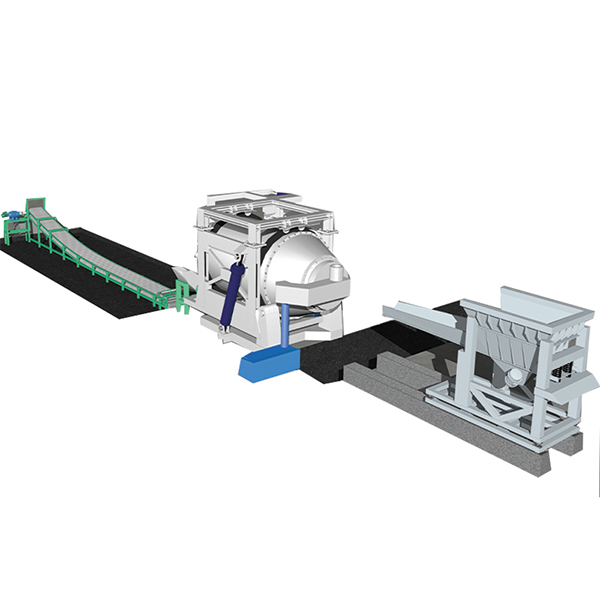
During the raw material processing stage, the rotary furnace serves as an indispensable tool for the volatilization roasting of antimony concentrates. Whether handling powdered or mixed antimony ores, the furnace facilitates their effective processing. By precisely controlling the internal temperature and reaction conditions, the antimony concentrates undergo a volatilization roasting reaction, yielding an antimony-rich oxide powder. This product serves as a high-quality feedstock for subsequent reduction smelting, thereby laying a solid foundation for the entire smelting workflow.
As the process transitions to the reduction smelting phase, the rotary furnace continues to play a vital role. Upon the addition of appropriate reducing agents into the furnace, and under high-temperature conditions, antimony trioxide is successfully reduced to crude antimony metal. This process is not only highly efficient but also ensures the quality of the crude antimony metal, meeting the stringent requirements of industrial production regarding antimony purity and performance.
Furthermore, the rotary furnace is capable of facilitating the resource recovery of intermediate products and waste residues generated during the smelting process—such as anode slimes and flue dust. Through specific adjustments to process parameters, these antimony-bearing residues undergo secondary treatment, enabling the comprehensive recovery of valuable metals. This approach not only enhances resource utilization efficiency but also minimizes waste emissions, thereby aligning with the principles of green development.
Additionally, the rotary furnace supports the preparation of alloys. It enables the co-smelting of crude antimony with other metals—such as lead and copper—to directly produce industrial products like lead-antimony alloys, thereby meeting the diverse alloy material requirements of various industries.
Throughout the entire pyrometallurgical antimony smelting process—spanning from raw material treatment and resource recovery to alloy preparation—the rotary furnace comprehensively covers every operational stage; through its inherent versatility, it drives the efficient and sustainable development of the antimony smelting industry.