



NEWS&EVENTS
Home > News&Events > Company news > Working Principle of the Tilting Rotary Furnace for Aluminum Dross
In the aluminum processing and recycling industries, the resource-oriented treatment of aluminum dross is a critical link in achieving energy conservation, emission reduction, cost reduction, and efficiency improvement. As a highly efficient thermal processing device specifically designed for treating aluminum dross, the tilting rotary furnace distinguishes itself through its unique operating principle, demonstrating exceptional performance in the efficient separation of aluminum from dross.
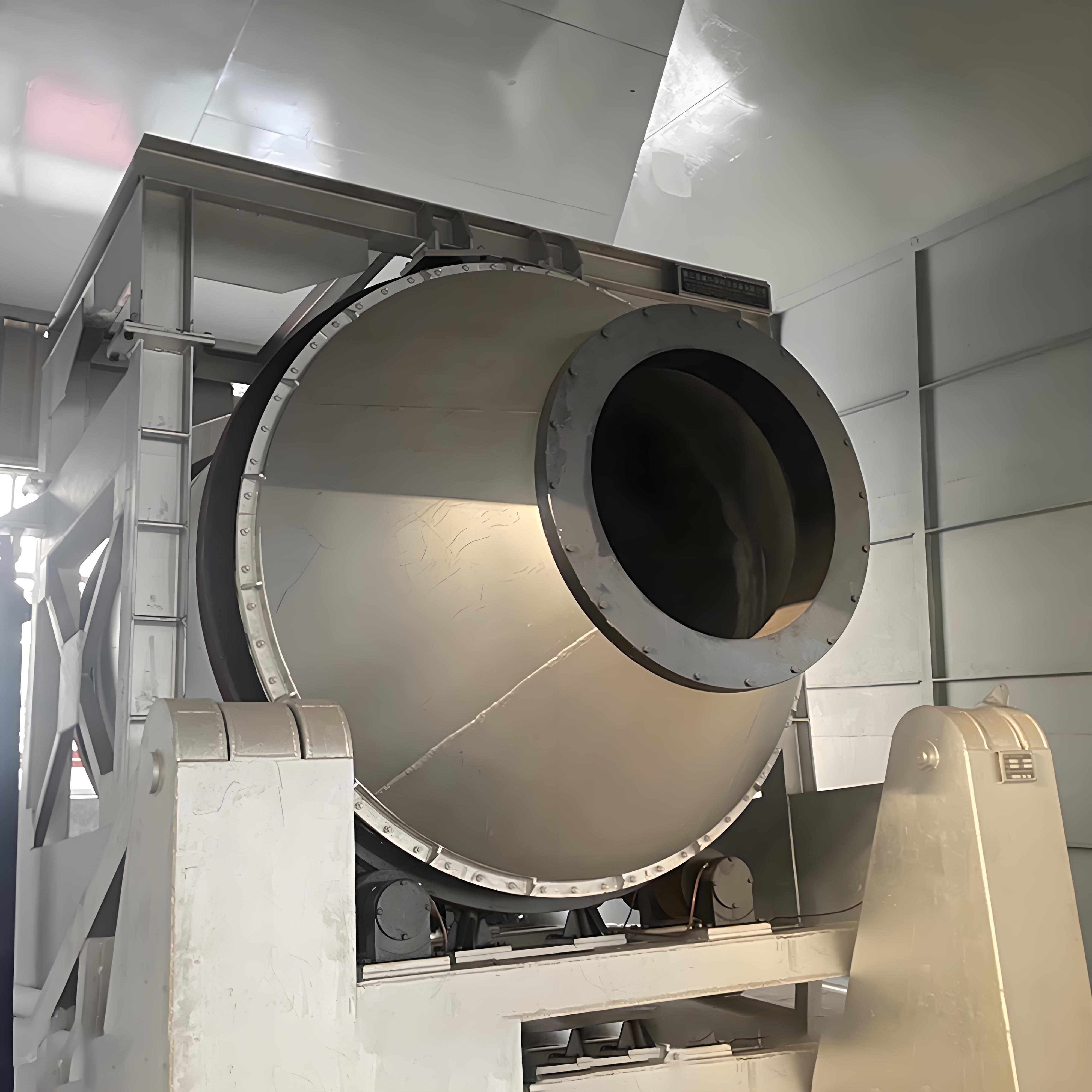
The tilting rotary furnace features a horizontal, rotatable cylindrical structure equipped with a hydraulic tilting system. During operation, hot or cold aluminum dross is charged into the furnace; driven by a dedicated mechanism, the cylinder rotates continuously at a specific speed, causing the dross to tumble and mix constantly within the furnace, thereby ensuring uniform heating of the material. Burners are utilized to raise the furnace chamber temperature to between 800°C and 1100°C; at these high temperatures, the metallic aluminum contained within the dross rapidly melts to form molten aluminum. Since the density of molten aluminum is significantly higher than that of the dross, the liquid aluminum naturally settles to the bottom of the furnace while the dross floats on the surface, thereby achieving an efficient separation of aluminum from the dross.
Upon completion of the smelting process, the hydraulic tilting system actuates the furnace body to tilt toward the discharge port (at an angle ranging from 0° to 45°). The molten aluminum flows smoothly out along the discharge chute, while the residual dross is subsequently discharged by inverting the furnace body, thereby completing a full operational cycle.
In summary, by leveraging a combination of rotary mixing and high-temperature melt separation, the tilting rotary furnace enables the efficient, energy-saving, and clean recovery of aluminum from dross, making it an ideal piece of equipment for aluminum industry enterprises seeking to achieve the resource-oriented utilization of aluminum dross.