



NEWS&EVENTS
Home > News&Events > Company news > Common Faults and Remedial Measures for Electrolytic Copper Cathode Stripping Units
The six most common faults encountered in electrolytic copper cathode stripping units are: uneven robotic stacking, a high failure rate in the flipping wheel mechanism, short service life of the washing chains, a high failure rate in the strapping system, corrosion of the separation frame, and general management issues. To address these faults, the primary measures are as follows:
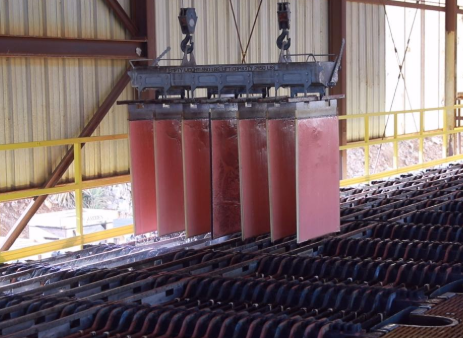
1. Uneven Robotic Stacking
The root cause lies in uneven radial forces acting on the gripper guide rods, resulting in unsynchronized gripper movements. The solution involves replacing the original copper bushings with linear rolling bearings, or adopting a four-point synchronous clamping mechanism that converges from all sides to clamp the cathode plates, thereby effectively improving stacking alignment.
2. High Failure Rate of the Flipping Wheel
Failures are primarily concentrated in components with insufficient acid resistance, as well as fatigue fractures of the reducer's spline shaft and the drive shaft flange. Measures: Upgrade the material of the drive shaft and adopt a three-section shaft design to improve stress distribution, thereby reducing the risk of fatigue fracture.
3. Short Service Life of Washing Chains
Under acidic corrosive conditions, the insufficient hardness of 316L stainless steel chains leads to rapid wear; the spacing teeth are prone to damage; and the secondary washing water causes corrosion to the frame structure. Improvement measures: Replace the frame with 304 stainless steel; upgrade the chains and sprockets to high-hardness, corrosion-resistant materials; and optimize the structure of the spacing teeth to prevent bolt fractures.
4. High Failure Rate of the Strapping System
As this involves numerous intricate details, it is recommended to conduct a dedicated, comprehensive troubleshooting audit of the strapping system, optimizing each aspect—mechanical, electrical, and control—sequentially.
5. Corrosion of the Separation Frame
Prolonged exposure to acidic operating environments leads to a degradation in material strength. The entire frame structure should be replaced with 304 stainless steel; additionally, inspections of the conductive rod plating and routine anti-corrosion spot checks should be intensified to prevent the spread of corrosion.
6. Comprehensive Management Enhancement
Strengthen adherence to Standard Operating Procedures (SOPs) to minimize human error; reinforce routine maintenance practices to ensure early detection and prompt resolution of issues; and prioritize specialized maintenance expertise as the core strategy to enhance the efficiency of resolving major equipment failures.
Through the aforementioned technical improvements and management optimizations, the overall failure rate of the unit can be significantly reduced, thereby ensuring the continuity and stability of cathode copper production.