



NEWS&EVENTS
In the industrial wet-process production of antimony trioxide, equipment selection directly impacts product quality, production efficiency, and operating costs. This article analyzes the operational characteristics of core equipment across four key stages: crushing, grinding, leaching, and filtration.
Crushing Stage: Jaw Crusher
Raw materials first enter a jaw crusher for primary crushing. Characterized by a simple structure, reliable operation, and an adjustable crushing ratio, the jaw crusher provides a uniform feed for the subsequent ball milling process, effectively minimizing over-pulverization.
Grinding Stage: Ball Mill
Coarsely crushed material enters a ball mill for fine grinding. Utilizing the impact and grinding action of steel balls as the cylinder rotates, the ball mill reduces the material to the required fineness of 200 mesh. This particle size significantly increases the material's specific surface area, ensuring thorough contact between the leaching agent and the antimony-bearing components—a critical factor for the efficiency of the subsequent leaching reaction.
Leaching Stage: Leaching Tank
As the wet process involves chlorine gas and requires heating to accelerate the reaction, leaching tanks are constructed from materials resistant to high temperatures, chlorine corrosion, and mechanical vibration. The tanks are equipped with agitators to enhance solid-liquid mixing and diffusion, as well as heating systems for precise temperature control, ensuring a complete and uniform leaching reaction.
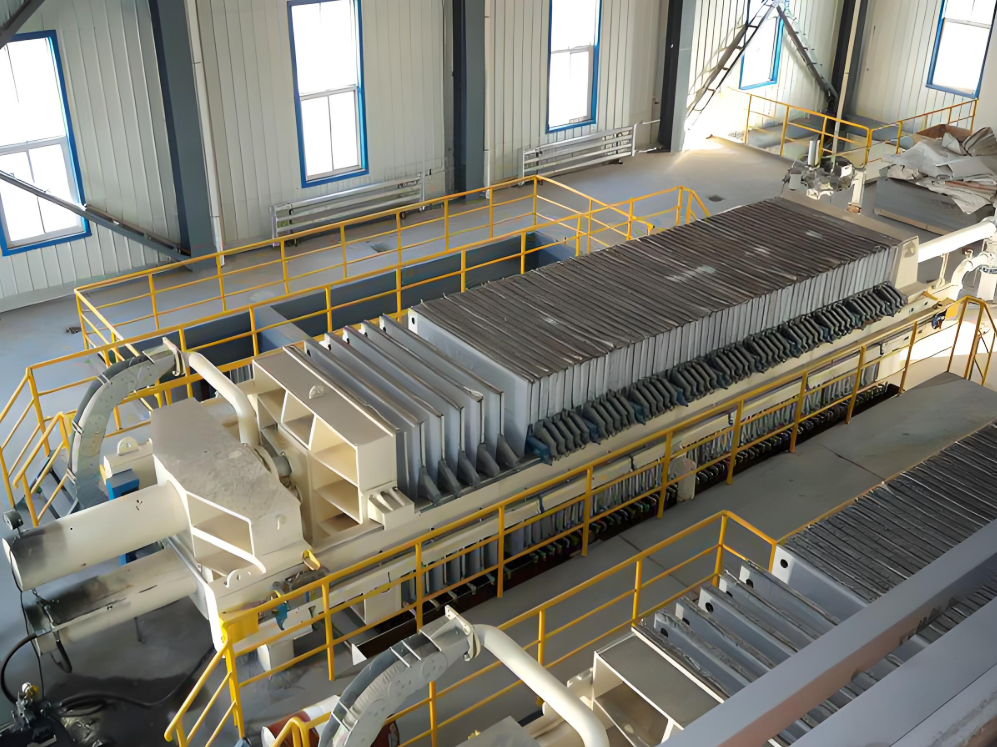
Filtration Stage: Plate-and-Frame Filter Press
The plate-and-frame filter press performs solid-liquid separation across multiple stages, including the initial separation of leachate from residue, purification of the reduction mother liquor, separation of the mother liquor following hydrolysis and precipitation, and final dewatering of the dechlorinated product. Offering advantages such as a large filtration area, high operating pressure, and low filter cake moisture content, this equipment meets multi-stage separation requirements, ensuring product purity and improving mother liquor recycling efficiency.
In summary, the jaw crusher, ball mill, leaching tank, and plate-and-frame filter press work in concert to form the complete production line for the wet-process manufacture of antimony trioxide. Proper selection and maintenance of this equipment are essential for enhancing production efficiency, reducing energy consumption, and ensuring product quality.