



NEWS&EVENTS
Stibnite (primarily Sb₂S₃) is a key raw material for the production of antimony trioxide (Sb₂O₃). Hydrometallurgy has become the prevailing process route due to its environmental friendliness and high metal recovery rates. This article provides a systematic overview of the key equipment configurations for this process.
Raw material pretreatment is the initial stage of the process. Stibnite ore undergoes coarse crushing in a jaw crusher to reduce large chunks to a moderate particle size, followed by fine grinding in a ball mill to ensure full mineral liberation, thereby creating favorable conditions for the subsequent leaching reaction. This stage places high demands on the wear resistance of the equipment.
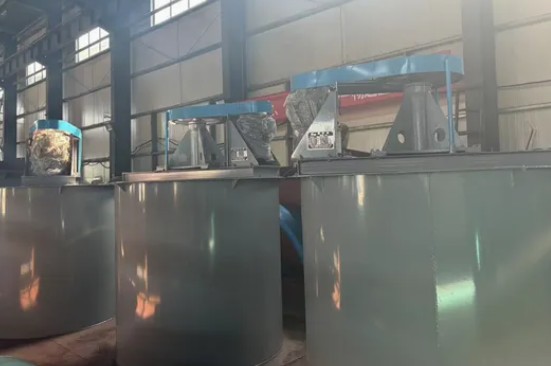
The core reaction unit is the leaching tank. In the hydrometallurgical process, the Sb₂S₃ in the stibnite is oxidatively leached in an acidic or alkaline medium, converting it into soluble antimony salts. The leaching tank must be equipped with an agitation system to ensure thorough solid-liquid contact and must possess excellent corrosion resistance, featuring either an anti-corrosive lining or stainless steel construction. Parameters such as temperature, pH value, and redox potential must be controlled during leaching, as they directly influence the antimony leaching rate and selectivity.
A plate-and-frame filter press is used for the solid-liquid separation stage. Following leaching, the antimony-bearing solution and the tailings residue must be efficiently separated. The plate-and-frame filter press offers advantages such as a large filtration area, high operating pressure, and low filter cake moisture content; it compresses the leaching residue into a filter cake while yielding a clarified antimony-bearing leachate. Characterized by a high degree of automation and easy filter cloth cleaning, it is suitable for large-scale continuous production.
The separated leachate undergoes subsequent treatments—including purification, hydrolysis, and calcination—to ultimately yield the Sb₂O₃ product. The selection of equipment for the entire hydrometallurgical process requires a comprehensive assessment of raw material characteristics, production capacity, and environmental requirements to achieve the goal of economical and efficient production.