



NEWS&EVENTS
Home > News&Events > Company news > What are the core advantages of copper electrolytic cells in terms of production capacity and efficiency?
The core advantages of copper electrolytic cells in terms of production efficiency stem from the synergistic enhancement of three aspects: process intensification, technological integration, and intelligent control.
Process intensification serves as the primary driver. Optimizing circulation patterns and inter-electrode spacing accelerates ion migration and increases copper deposition. When combined with high-performance anodes and stable additives, this suppresses short circuits and impurity precipitation, enabling stable, long-term operation under high loads and thereby increasing the output of qualified products without extending the production cycle.
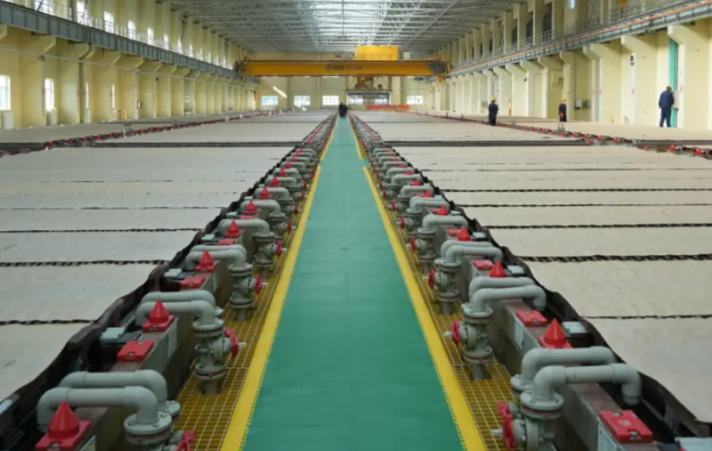
Advanced cell structures and electrolyte supply systems provide the necessary physical infrastructure. Integrally molded cells paired with precision busbars reduce contact resistance and heat loss, ensuring more uniform current distribution. Bidirectional or multi-directional circulation technologies maintain consistent temperature and concentration fields within the cell, preventing concentration polarization and minimizing downtime caused by concentration fluctuations, which extends effective operating time.
Intelligent monitoring and automated control systems transform traditional operational models. Online sensors provide real-time parameter feedback, allowing the system to issue early warnings and make automatic fine-tuned adjustments, thereby shortening response times for handling anomalies. Unmanned inspections and automated electrode handling reduce unplanned downtime caused by human error, enabling the cells to operate continuously at full capacity.
In summary, these advantages not only ensure product quality but also significantly boost capacity utilization while lowering energy consumption and maintenance costs. By enhancing process adaptability and economic efficiency, these electrolytic cells have become a critical component of modern copper smelting.