



NEWS&EVENTS
Home > News&Events > Company news > Two Processes for Producing Electrolytic Copper from Copper Oxide Ores
Oxidized copper ores are a vital copper resource. The production of electrolytic copper from them primarily employs two process routes—pyrometallurgy and hydrometallurgy—both of which ultimately yield high-purity copper cathodes through electrolytic refining.
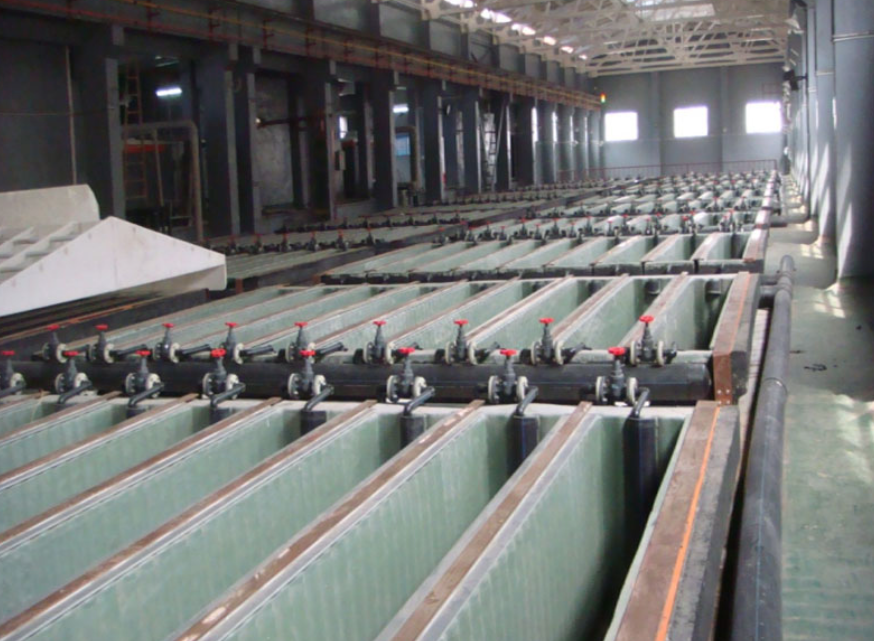
This route is suitable for high-grade oxidized copper ores. The raw ore is crushed and ground to an appropriate particle size, undergoing flotation enrichment if necessary. It then enters the smelting stage, where the ore reacts with silica, limestone, and coke in a reverberatory or flash furnace at 1200–1300°C to produce copper matte with a copper content of 40–75%. The matte is blown in a Pierce-Smith (PS) converter, undergoing staged oxidation to remove iron and sulfur, resulting in blister copper with 95–98% copper content. This blister copper undergoes further fire refining in an anode furnace (impurities are removed by air blowing during the oxidation stage, followed by reduction using wood poles or natural gas) and is cast into anode plates with ≥99.2% copper content. Finally, electrolytic refining is performed in an electrolyte containing 40–50 g/L Cu²⁺ and 180–200 g/L H₂SO₄ at a current density of 220–300 A/m², yielding copper cathodes with ≥99.95% copper content.
This route is the mainstream choice for processing low-grade oxidized copper ores. After crushing and grinding, the ore undergoes sulfuric acid leaching to dissolve the copper into ionic form. The pregnant leach solution is enriched and purified via solvent extraction and stripping to produce a high-concentration copper sulfate solution. Finally, this solution is fed into electrowinning cells; under the influence of direct current, copper ions deposit directly onto the cathode as electrowon copper (≥99.95% copper content).
Each process has its own advantages: the pyrometallurgical route is suited for high-grade ores, while the hydrometallurgical route is appropriate for low-grade oxidized ore resources; together, they constitute the modern electrolytic copper production system.