



NEWS&EVENTS
Home > News&Events > Company news > Process Principles and Quality Control of Cathode Copper Electrolysis Equipment
Copper electrolytic refining is a core process in hydrometallurgy; fundamentally, it utilizes electrochemical principles to purify blister copper and comprehensively recover valuable metals. In the electrolytic cell, blister copper anodes and pure copper starter sheets (or permanent cathodes) are connected to the positive and negative terminals of a DC power supply, respectively, and immersed in an acidic copper sulfate electrolyte. Upon the application of current, oxidation occurs at the anode, causing copper to enter the solution as ions. Meanwhile, noble metals such as gold and silver—due to their higher electrode potentials—do not dissolve but instead settle at the bottom of the cell as anode slime, serving as a vital raw material for noble metal recovery. Concurrently, copper ions undergo reduction at the cathode, depositing as high-purity copper. Impurities such as iron, nickel, and arsenic—characterized by more negative potentials—either remain in the solution or separate into the anode slime, thereby achieving deep purification of the copper.
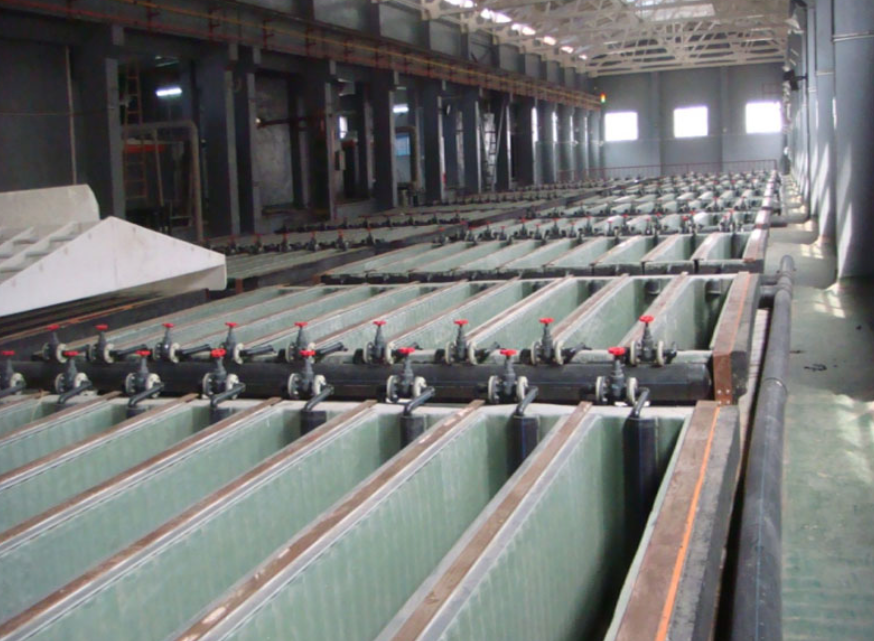
To ensure cathode copper quality and production continuity, the following aspects require rigorous control:
Short-circuit prevention: Regularly inspect electrode contact points, promptly remove copper sulfate crystals from conductive busbars, and replace worn insulation pads.
Additive management: Imbalances in additive ratios can lead to surface roughness and nodule formation on the cathode copper; therefore, regular monitoring and replenishment are essential.
Electrolyte purification: Remove impurities through processes such as vacuum evaporation, induced copper removal, and crystallization separation to maintain a stable electrolyte composition.
Through the aforementioned cathode copper electrolysis equipment processes and precision control, it is possible to stably produce cathode copper that meets delivery standards while efficiently recovering precious metals from anode slime, thereby achieving resource utilization.