



NEWS&EVENTS
Home > News&Events > Company news > Treatment of Electrolytic Antimony Anode Slime and Recovery of Valuable Metals
Anode slime generated during the antimony electrolysis process is rich in valuable metals such as Ag, Au, Cu, Bi, Se, and Te; the schemes for its treatment and metal recovery typically involve the following stages:
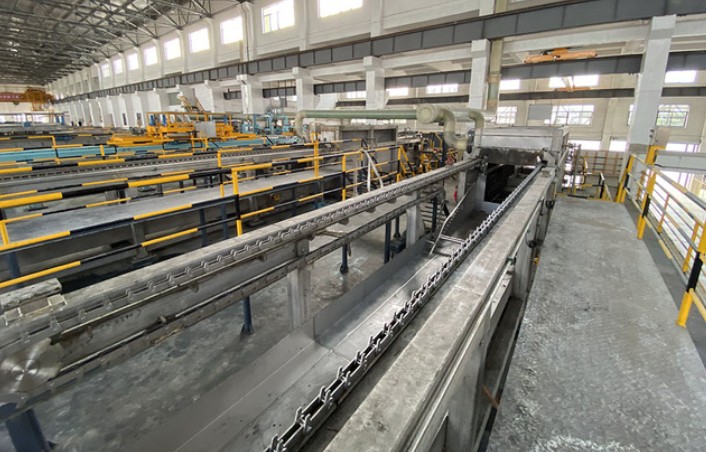
Anode slime collection: Slime hoppers or conical bottoms are installed at the base of the antimony electrolysis cells for periodic discharge; alternatively, continuous scraper conveyors may be used to transport the slime to collection tanks.
Washing and filtration: Vacuum filters or filter presses are used to remove the electrolyte, with the filtrate returned to the antimony electrolysis system.
Pyrometallurgical or hydrometallurgical recovery:
Pyrometallurgical method: The anode slime undergoes roasting, smelting, and converting to recover silver, gold, and other metals.
Hydrometallurgical method: Acid leaching, ammonia leaching, cyanidation, or thiourea leaching is employed, combined with electrowinning or displacement, to recover precious metals.
Equipment corrosion protection: As anode slime treatment often involves strong acids and strong oxidizing agents, equipment must be constructed using materials such as titanium, rubber lining, plastic lining, or fiberglass-reinforced plastic (FRP).
In summary, the treatment of antimony electrolysis anode slime requires a combination of pyrometallurgical and hydrometallurgical processes, along with a focus on corrosion-resistant materials for equipment, to achieve the efficient recovery of valuable metals.