



NEWS&EVENTS
Home > News&Events > Company news > From Antimony Ore to Sb₂O₃: Equipment for the Pyrometallurgical Process
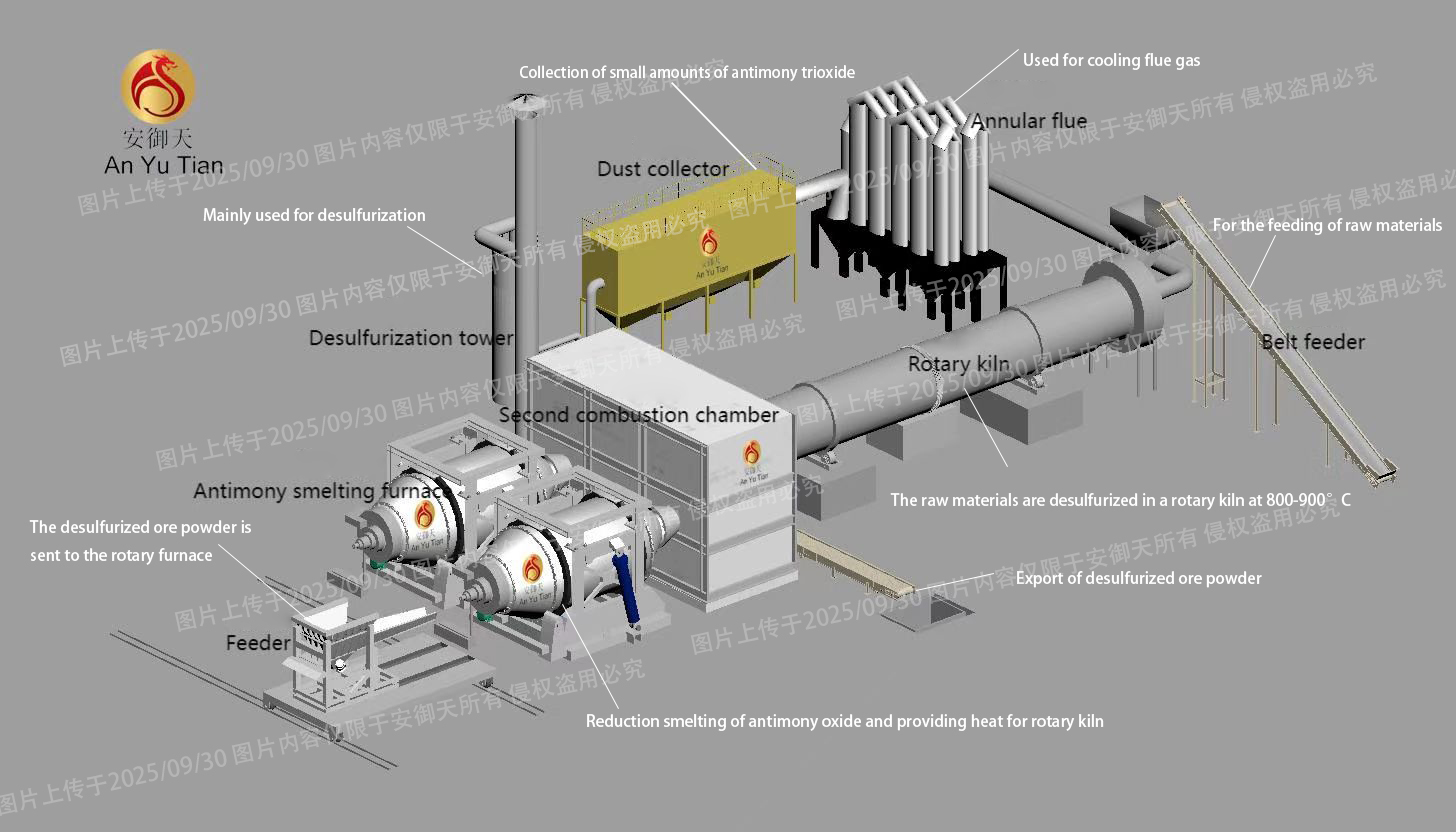
Antimony ore pyrometallurgy begins with a belt feeder, which smoothly delivers the raw ore into a rotary kiln. Roasting desulfurization is carried out at a high temperature of 800–900°C. The desulfurized ore powder is discharged from the outlet and precisely fed into the rotary furnace by a feeder, preparing for reduction smelting.
The rotary furnace is the core equipment, where the ore powder undergoes high-temperature reduction smelting to produce crude antimony metal. At the same time, it supplies heat to the rotary kiln, achieving energy recycling, improving efficiency, and reducing energy consumption. High-temperature flue gas enters an annular flue for initial cooling, then passes through a bag filter to recover a small amount of valuable antimony trioxide, and finally enters a desulfurization tower for purification and compliant emission.
Crude antimony and a refining agent are charged into a refining furnace to obtain purified antimony liquid. The antimony liquid enters a continuous casting machine to produce antimony ingots, which are automatically stacked and bundled by a robotic stacking machine. If antimony oxide powder is to be produced, the antimony liquid is oxidized in an oxidation furnace to form antimony trioxide, which volatilizes at high temperature into the dust collection system and is collected as Sb₂O₃ powder in the bag filter.
The rotary furnace runs through the entire antimony ore pyrometallurgical process and works in coordination with the rotary kiln, bag filter, and desulfurization tower to ensure an efficient and environmentally friendly process, providing a solid equipment foundation for antimony product production.