



NEWS&EVENTS
Home > News&Events > Company news > What are the main systems or components that constitute the body of a copper converter?
Copper converters (taking the currently most prevalent horizontal Peirce-Smith converter as an example) differ significantly in structure and composition from steelmaking converters. Their core systems or components primarily comprise the following aspects:
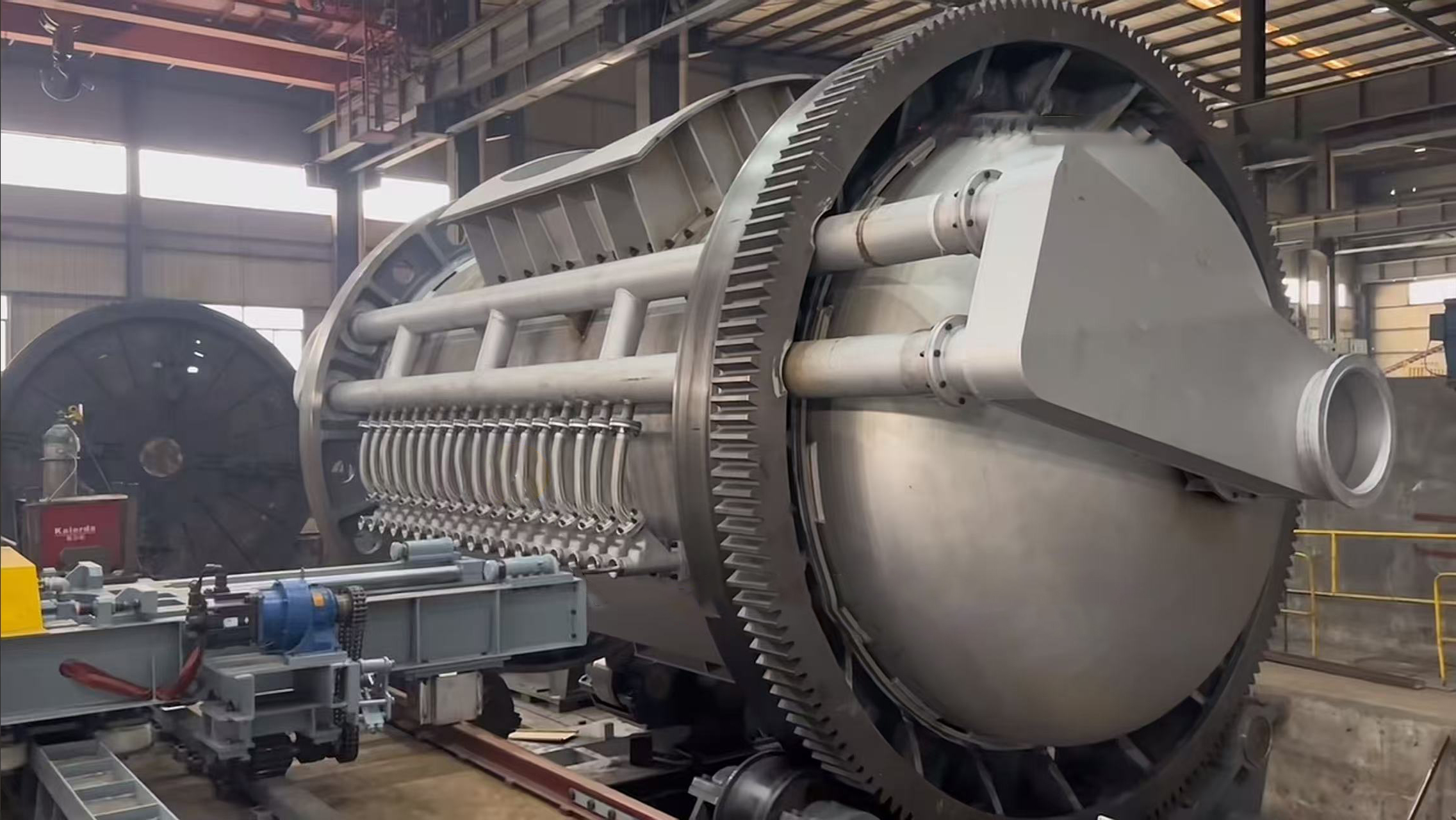
Furnace Shell:This serves as the central vessel for smelting operations. It primarily consists of an outer shell welded from thick steel plates, lined internally with high-temperature-resistant and corrosion-resistant refractory bricks—specifically magnesia, magnesia-chrome, or chrome-magnesia bricks. A furnace mouth is situated in the central section of the shell, serving as the portal for charging, fume extraction, slag tapping, and copper tapping. The sides of the furnace shell are typically fitted with riding rings (tires), which support the shell upon trunnion rollers and facilitate its rotation.
Support Mechanism:Designed to support and stabilize the entire furnace shell, this mechanism primarily consists of a set of support rollers (trunnion rollers) and a set of guide rollers (thrust rollers). The support roller assembly typically comprises multiple pairs of rollers upon which the furnace shell rests via its riding rings; the guide rollers serve to prevent axial shifting or drift of the furnace shell during rotation.
Drive Mechanism:This system is responsible for rotating the furnace shell to meet the specific requirements of various production stages. It typically consists of an electric motor, a speed reducer, a pinion gear assembly, and a large girth gear (ring gear) affixed to the furnace shell; rotation is achieved through the meshing action of these gears.
Air Supply System (Tuyere Assembly):This system is used to inject compressed air into the molten bath within the furnace and constitutes a critical element for driving the necessary oxidation reactions. Structurally, it typically features a horizontal row of tuyeres (air ports) positioned along one side of the furnace shell, through which compressed air is blown in to facilitate the refining process. The system primarily comprises air ducts and the tuyeres themselves; as the tuyeres are consumable components, they require periodic maintenance and replacement.
Refractory Materials: Serving as the internal lining of the furnace, these materials are in direct contact with the high-temperature molten bath (copper matte, blister copper), slag, and the erosive force of the gas flow. The primary materials utilized are magnesia, magnesia-chrome, or chrome-magnesia bricks; their performance and quality are the decisive factors determining the service life (campaign life) of the converter.
Furthermore, to ensure smooth operations, environmental compliance, and safety, the converter is also equipped with a hood system (designed to capture the high-temperature, SO₂-rich off-gas generated during smelting), fire protection devices, a flux feeding system (used to introduce slag-forming fluxes such as quartz), and a control system to facilitate the automated management of the entire production process.