



NEWS&EVENTS
Home > News&Events > Company news > Functional Differences Between Rotary Kilns and Rotary Furnaces in Antimony Smelting
In the pyrometallurgical process for antimony refining, the rotary kiln and the rotary furnace constitute two distinct operational units; their functional roles are clearly defined and must not be confused or used interchangeably.
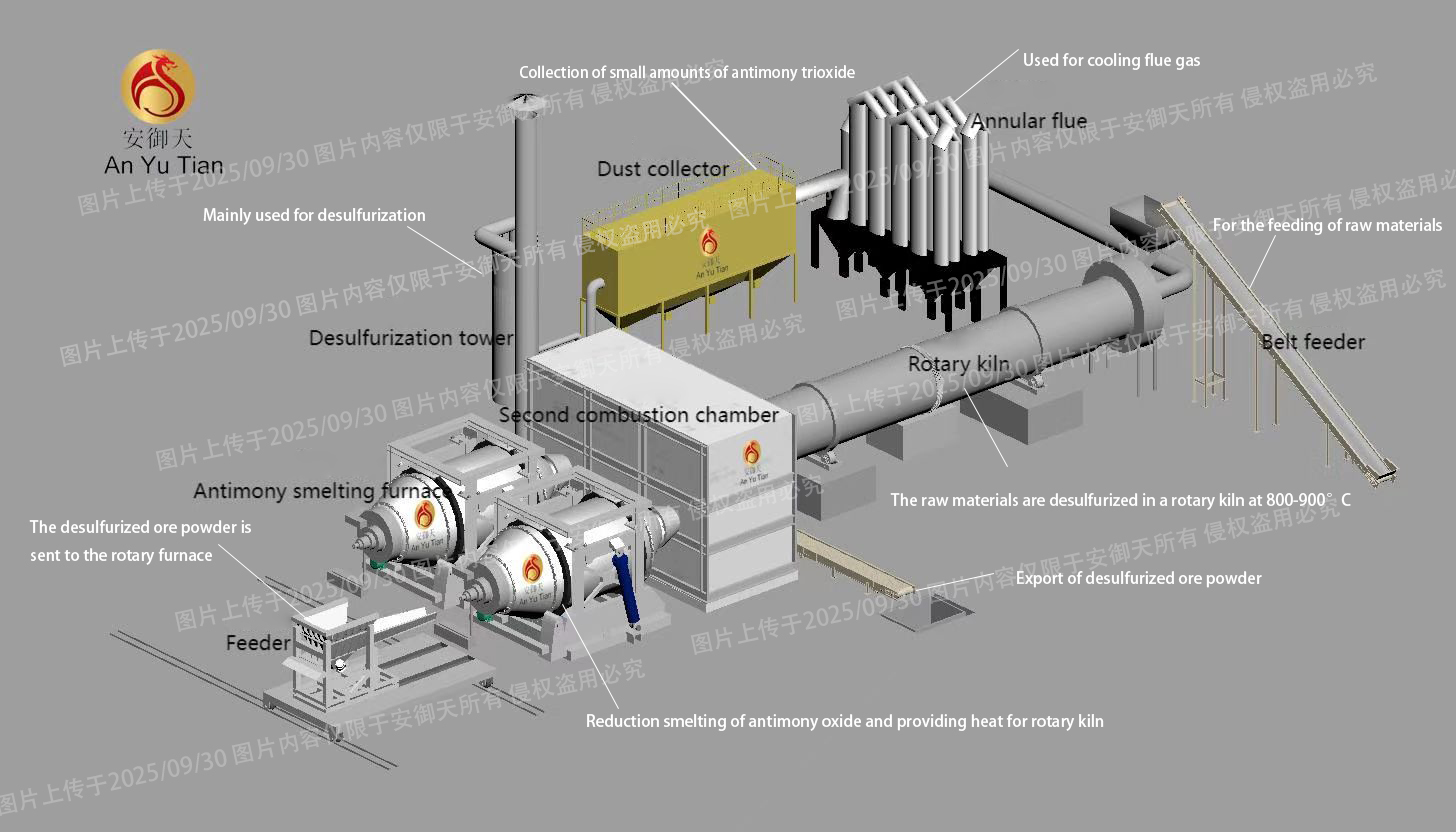
Rotary Kiln: Oxidative Roasting—No Metal Production
The rotary kiln is tasked with the "pretreatment" function. It heats the antimony ore to temperatures ranging from 800°C to 900°C, subjecting it to desulfurizing roasting within an oxidizing atmosphere. The sulfur present in the ore combines with oxygen to form sulfur dioxide (SO₂), which enters the flue gas system for subsequent acid production or desulfurization; meanwhile, the antimony transforms from its sulfide form into an oxide form that is readily amenable to reduction. The product of this stage is roasted ore powder—not metallic antimony. Simply put, the role of the rotary kiln is "sulfur removal and transformation," thereby establishing the necessary raw material conditions for the subsequent reductive smelting process.
Rotary Furnace: Reductive Smelting—Production of Crude Antimony
The rotary furnace, conversely, is responsible for the "final output." Operators charge the roasted ore powder—produced by the rotary kiln—into the furnace alongside reducing agents such as anthracite and coke, where reductive reactions are carried out at even higher temperatures. The reducing agents strip the oxygen from the antimony oxides, thereby reducing them into molten crude antimony metal. This stage directly yields the metallic product and constitutes the core smelting link within the entire antimony refining workflow.
It is precisely this clear functional division and the seamless integration of process stages that form the foundation for the efficient and clean production characteristic of modern antimony metallurgy. Understanding the fundamental distinctions between the rotary kiln and the rotary furnace is essential for accurately grasping the underlying process logic of pyrometallurgical antimony refining.