



NEWS&EVENTS
Home > News&Events > Company news > Configuration of Auxiliary Smelting and Casting Equipment for Scrap Copper
Scrap copper undergoes pyrometallurgical refining—calcined at high temperatures to remove impurities—and is ultimately transformed into molten copper. However, this molten copper is not yet the final product; it must be shaped into a standardized form—the anode plate—before proceeding to the electrolytic workshop to complete the transition from scrap to pure copper. The key to achieving this transformation is the quantitative copper anode casting system, an ingenious assembly integrating mechanical, hydraulic, and control technologies.
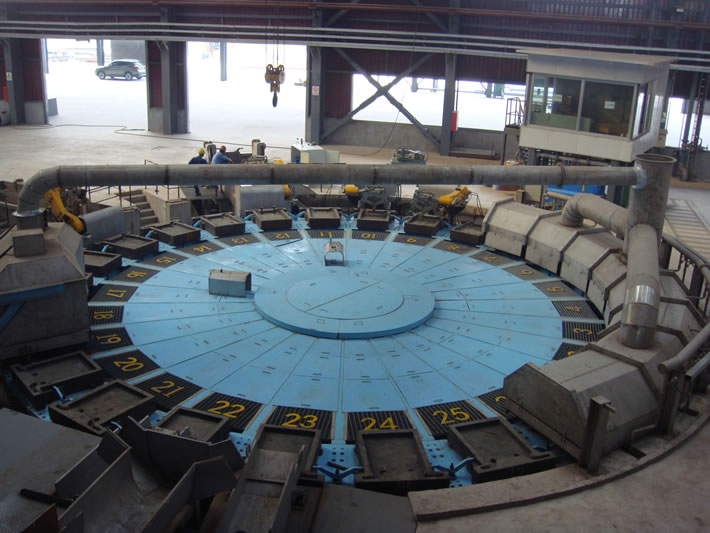
The core mission of this equipment suite is precision and efficiency. The entire system operates through the coordinated efforts of several key components:
Tundish: Receives the surging flow of molten copper from the refining furnace and delivers it to the next stage in a stable, controlled manner.
Casting Ladle and Weighing Unit: Once the ladle receives the molten copper, the weighing unit beneath it monitors weight changes in real-time. When the copper reaches the preset anode weight, the system issues precise commands to ensure exact dosing—the foundation for uniform anode specifications.
Hydraulic Drive System: This system powers all the precise movements, providing the smooth yet robust force needed to tilt the ladle and operate the gate mechanism, allowing the molten metal—heated to over a thousand degrees—to flow smoothly under command.
Rotary Casting Machine: Molten copper is poured into molds mounted on the rotary casting machine. This massive turntable rotates slowly, carrying the molds sequentially through the casting, cooling, and ejection stations. The copper cools and solidifies within the molds before being ejected as uniform anode plates.
From rushing molten metal to neatly stacked solid slabs, the form of the scrap copper is reshaped here. This quantitative casting system acts not merely as a heavy-duty transporter but as a precision caster; by utilizing automation and quantitative control technologies, it lays a solid foundation for the subsequent high-efficiency electrolytic refining process.