



NEWS&EVENTS
Home > News&Events > Company news > Copper Electrolysis: Advantages and Applications of Permanent Stainless Steel Cathodes
In the field of copper electrolytic refining, the evolution of cathode technology represents the most significant process advancement. Traditional methods long relied on copper starter sheets as cathodes; this approach necessitated a dedicated starter-sheet production system involving cumbersome steps such as sheet formation, embossing, trimming, and hoisting, which not only required substantial space and equipment investment but also increased the complexity of production management.
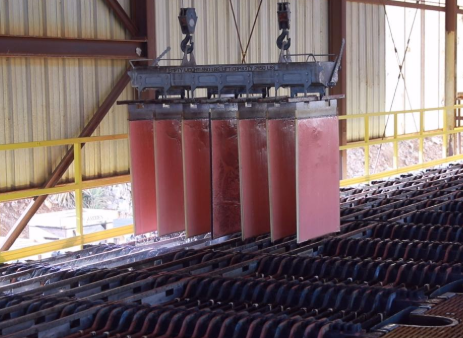
The successful implementation of the permanent stainless steel cathode process (also known as the ISA process) has revolutionized this landscape. This groundbreaking technology replaces copper starter sheets with stainless steel plates, enabling the cathodes to be reused indefinitely.
Permanent stainless steel cathode plates offer several key advantages. First, their excellent electrical conductivity ensures uniform current distribution, thereby enhancing electrolytic efficiency. Second, their superior mechanical strength prevents deformation during prolonged use. Third, their outstanding corrosion resistance guarantees a stable service life even in highly acidic electrolytes.
Crucially, stainless steel cathode plates exhibit superior flatness and verticality, characteristics that allow for a significant reduction in inter-electrode spacing within the electrolytic cells. Narrower spacing means more cathode and anode plates can be accommodated in the same cell volume, thereby substantially increasing system productivity per unit volume. Furthermore, by eliminating the need for starter sheets—and leveraging the plates' excellent conductivity and verticality—the process yields high-quality cathode copper characterized by smooth surfaces and dense crystalline structures.
In practice, permanent stainless steel cathode technology has been widely adopted by major copper smelters worldwide. It has not only simplified process workflows and reduced operating costs but has also driven the copper electrolysis industry toward larger-scale, automated, and highly efficient operations.