



NEWS&EVENTS
Home > News&Events > Company news > What are the requirements regarding the structure and materials of copper electrolytic cells?
As the core vessel for electrolytic refining, the copper electrolytic cell's structure and material selection directly determine production efficiency, product quality, and equipment longevity.
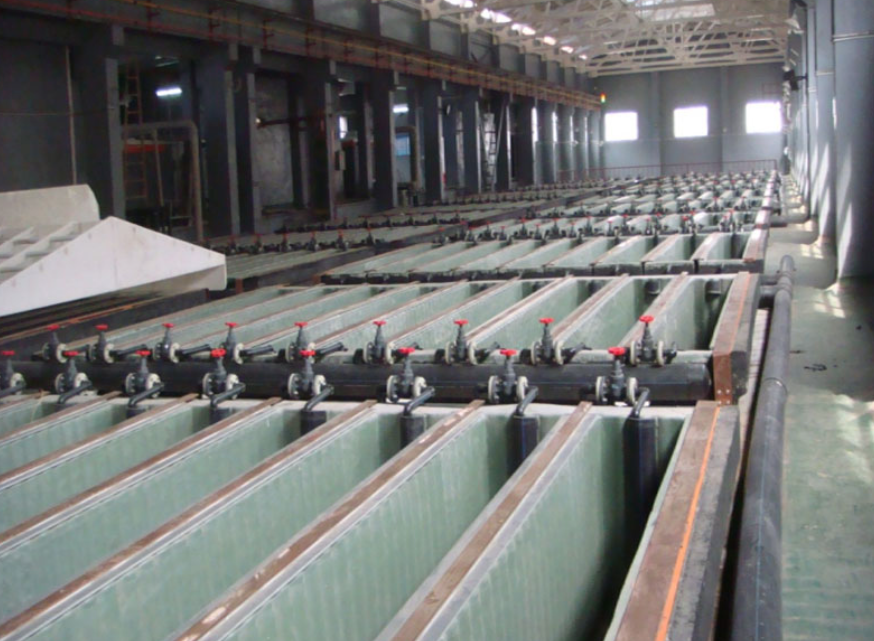
Regarding the structural framework, reinforced concrete is commonly used as the load-bearing skeleton to ensure overall rigidity and resistance to deformation. The inner walls must be covered with a dense, anti-corrosive lining to isolate the base structure from the corrosive electrolyte. The cell is typically rectangular in design, facilitating the orderly arrangement of electrode plates and the circulation of the solution.
Material selection varies according to specific component requirements. The main body of the cell is often cast as a single unit using vinyl ester resin; this material offers excellent acid corrosion resistance and high compressive strength, enabling it to withstand the chemical attack and mechanical stress of hot, acidic electrolytes over the long term. Circulation piping systems utilize reinforced polypropylene, which offers good chemical stability, low weight, and ease of installation—making it ideal for transporting hot, acidic solutions containing copper ions.
In terms of advanced technology, integrated casting techniques for bidirectional parallel-flow channels are employed. This process molds the flow channels and the cell body as a single unit, eliminating the weak joints found in traditional assembled structures. This significantly enhances compressive strength, reduces the thermal expansion coefficient, and promotes uniform current density distribution within the cell, thereby facilitating the even deposition of cathode copper. Additionally, the cell bottom is often designed with a slope to facilitate the settling and collection of anode slime.
In summary, the materials for copper electrolytic cells must meet requirements for corrosion resistance, high strength, and longevity, while the structural design must balance principles such as uniform flow fields, electrode stability, and ease of operation. Combining appropriate material selection with optimized structural design effectively extends the cell's service life and ensures the stable production of high-purity cathode copper.