



NEWS&EVENTS
Home > News&Events > Company news > Overview of Cathode Copper Electrolytic Production Equipment | Rectifiers, Electrolytic Cells, and Stripping Units
The electrolytic refining process for cathode copper relies on a highly automated equipment system. To ensure current efficiency and cathode copper quality, the production line requires four core equipment groups: power supply, electrolysis, electrolyte circulation, and mechanized operations. The key equipment is listed below by functional module, suitable for process design, equipment selection, and technical proposal drafting for copper smelters.
1. Power Supply System (Rectifier Units)
Rectifier transformer: Steps down high-voltage AC power.
Silicon rectifier: Converts AC power into low-voltage, high-current DC power.
Automatic constant-current control system: Regulates current density in real-time to ensure process stability.
Cooling unit (air or water cooling): Dissipates heat from rectifier components.
2. Core Electrolytic Reaction Equipment
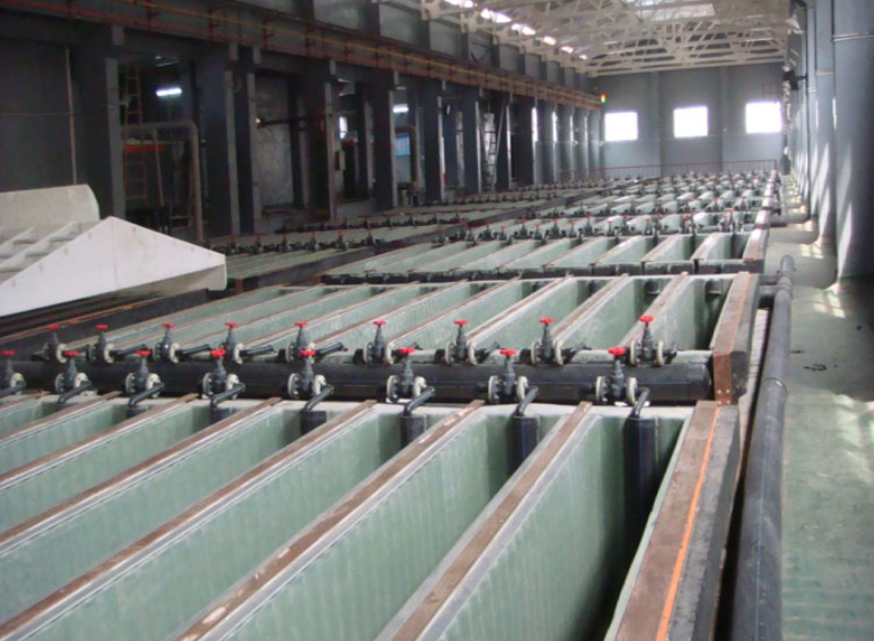
Electrolytic cell: Reinforced concrete structure with PP lining; corrosion-resistant and leak-proof; houses anode and cathode plates.
Permanent cathode plate: Stainless steel; serves as the substrate for copper deposition; reusable.
Anode plate: Cast from blister copper; gradually dissolves during the electrolysis process.
Conductive busbars and contact points: Copper or aluminum bars connecting electrode plates to the power supply system, ensuring uniform current distribution.
3. Electrolyte Circulation, Temperature Control, and Purification System
Circulation pump: Forces electrolyte flow between the cell bank and the head tank.
Head tank (constant-pressure tank): Maintains constant liquid head pressure to ensure uniform electrolyte feed to each cell.
Plate heat exchanger and electric heater: Work together to stabilize electrolyte temperature at 60–65°C.
Precision filter: Continuously filters suspended particles and removes harmful impurities such as arsenic, antimony, and bismuth.
Piping and valves: Acid-resistant materials (e.g., CPVC, titanium piping) connecting circulation units.
4. Mechanized Operation and Material Handling Equipment
Cathode stripping unit: Automatically strips, washes, and stacks deposited copper from stainless steel cathode plates.
Anode shaping and processing unit: Flattens and corrects spent anodes and recovers anode scrap. Anode Preparation Unit: Hoists new anode plates and positions them precisely within the electrolytic cells.
Washing and Stacking Unit: Cleans, weighs, and bundles the finished copper plates.
Specialized Electrolysis Crane: Features a corrosion-resistant and non-magnetic design; used for loading and unloading plates from cells, inter-bay transfer, and linking process units.